
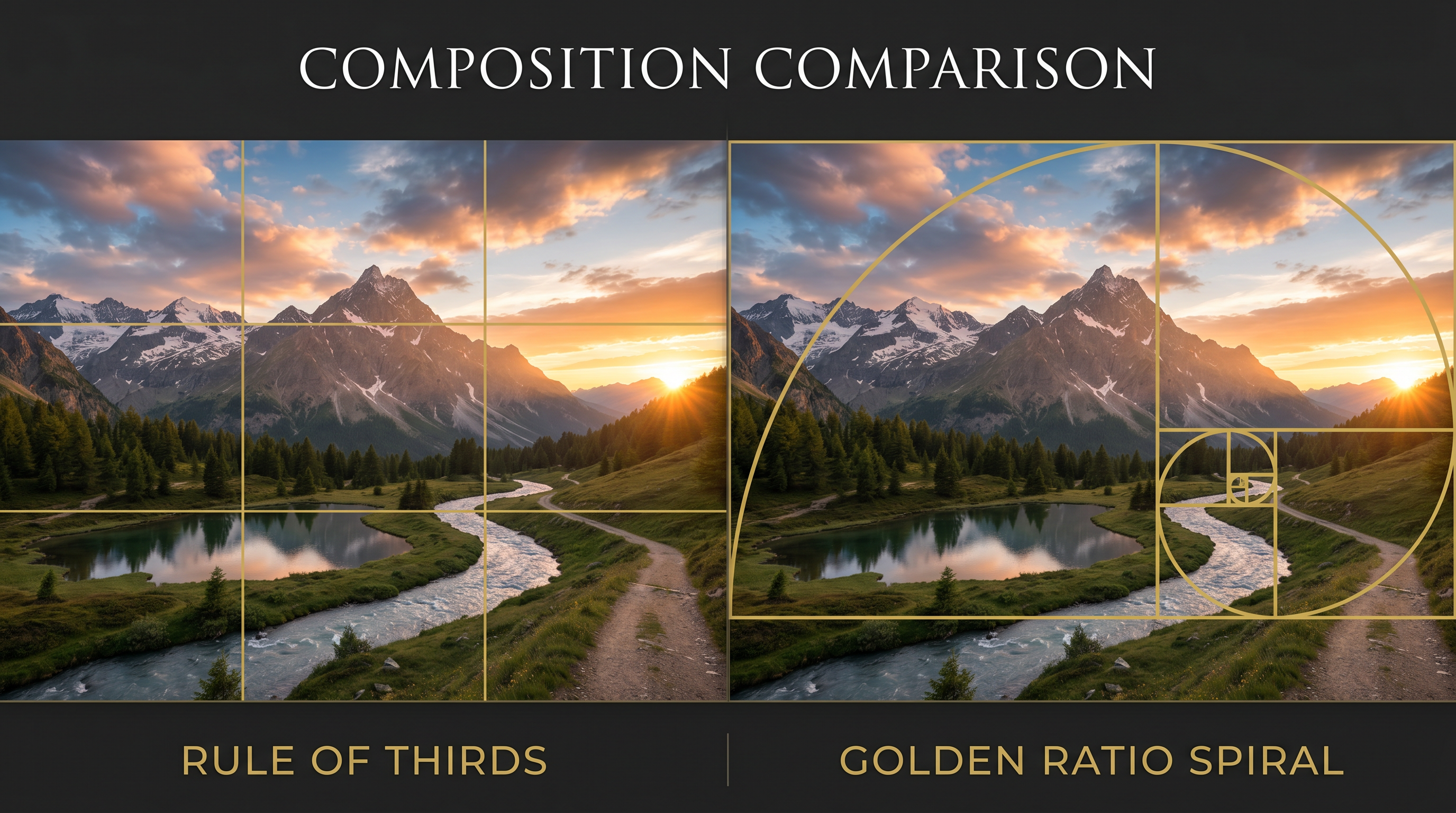
Rule of Thirds vs Golden Ratio: Ultimate Guide to Photography Composition Mastery
Imagine capturing a sunset over jagged mountains, where the sun dips just so, drawing the eye inexorably across the frame. Or a portrait where the subject's gaze pierces through, balanced yet alive with tension. These aren't accidents—they're the alchemy of masterful photography composition. At the heart of it all lies a timeless debate: rule of thirds vs golden ratio. Which compositional powerhouse elevates your shots from snapshot to masterpiece?
Whether you're framing epic landscapes, intimate portraits, or digital designs, understanding these techniques unlocks visual harmony. This ultimate guide dives deep, comparing the rule of thirds and golden ratio (powered by phi and the golden spiral), with practical tips, device settings, and expert scenarios. Ready to transform your compositions? Let's break it down.
Understanding the Rule of Thirds: The Cornerstone of Dynamic Composition
Picture an invisible tic-tac-toe grid overlaying your viewfinder. That's the rule of thirds in action—dividing your frame into nine equal parts with two horizontal and two vertical lines. The magic? Place key elements along these lines or at their intersections for instant balance and energy.
Born from classical painting traditions, this technique exploded in photography because it's simple, intuitive, and camera-friendly. Most devices offer a thirds grid toggle, turning theory into practice mid-shoot.
Why It Works: Guiding the Eye Naturally
Humans don't stare at centers; we scan. The rule mimics this, creating asymmetry that feels dynamic. In landscape photography tips, position the horizon on the upper or lower third line—never dead center—for breathing room and depth.
- Horizons: Lower third for vast skies, upper for reflective waters.
- Foregrounds: Align leading lines to intersections for pull-in power.
- Portraits: Eyes at top-third intersections spark connection.
Pro tip: Activate the grid on your smartphone (iPhone: Settings > Camera > Grid; Android: Camera app settings). DSLRs like Canon/Nikon? Menu > Grid Display > Rule of Thirds.
Decoding the Golden Ratio: Nature's Mathematical Symphony
Enter phi (φ ≈ 1.618), the irrational number echoing through nautilus shells, galaxies, and Renaissance art. The golden ratio stems from this, forming rectangles where the ratio of longer to shorter sides is phi. Slice it repeatedly, and you get the golden spiral—a logarithmic curve that pulls the eye in hypnotic flow.
Unlike the rigid grid of thirds, the golden ratio is organic, curving through compositions like a river. Artists like Salvador Dalí and photographers like Sebastião Salgado swear by its subtle harmony (without quoting them directly—observe their works).
Golden Spiral and Phi Grid: Tools for Effortless Flow
Overlay a golden spiral to position subjects at its tightest curve, with elements spiraling outward. The phi grid? A more precise tic-tac-toe with phi-proportioned segments—narrower lines for nuanced placement.
In portrait composition, curve the spiral from face to shoulder; landscapes thrive with mountains funneling into the spiral's heart.
Rule of Thirds vs Golden Ratio: A Head-to-Head Comparison
So, which wins in the rule of thirds vs golden ratio showdown? Neither—each shines differently. Here's a breakdown:
| Aspect | Rule of Thirds | Golden Ratio |
|---|---|---|
| Origin | Painting grids, simplified math | Fibonacci sequence, nature (phi) |
| Ease of Use | High—built-in on most cameras | Medium—needs overlays/apps |
| Visual Effect | Dynamic, asymmetrical energy | Organic, harmonious flow |
| Best For | Landscape photography tips, action | Portrait composition, abstracts |
| Pros | Quick, versatile, beginner-friendly | Timeless elegance, eye retention |
| Cons | Can feel mechanical | Complex to apply live |
This table highlights why blending them amplifies photography composition mastery.
Applying the Rule of Thirds: Step-by-Step in Real Scenarios
Landscape Photography Tips with Thirds
Hiking a coastal trail? Grid on, horizon low third, foreground rocks at left intersection. The sea pulls right, sky dominates—balance achieved. Device hack: iPhone Live Photos grid persists; Samsung Galaxy: Pro mode > Grid lines > 3x3.
Portrait Composition Power
subject's eyes top-right intersection, chin lower line. Tension builds, story unfolds. Mirrorless like Sony A7? Custom button for grid toggle.
- Frame wide, crop later.
- Scan intersections first.
- Break it for impact—center for symmetry.
Harnessing the Golden Spiral and Phi Grid: Advanced Techniques
Apps like Adobe Lightroom or PhiMatrix overlay the golden spiral. Rotate to fit: subject at core, details spiraling out. In digital art, Photoshop actions automate phi grids.
For devices: Lightroom Mobile > Overlays > Golden Ratio. iPad Procreate brushes align to phi naturally.
Expert Device Settings for Golden Ratio
- Fuji X-Series: Custom grid download (phi via apps).
- Android (Pixel): GCam mods with overlays.
- Post-Processing: Affinity Photo phi matrix tool.
Expert Advice: When to Choose Rule of Thirds vs Golden Ratio
Rule of thirds for fast-paced shoots—street, wildlife—where speed trumps subtlety. Golden ratio? Portraits, product design, fine art craving that 'natural' pull.
In chaotic scenes, thirds inject order; in serene ones, golden whispers eternity.
Hybrid hack: Start with thirds, refine with spiral in edit. Composition techniques evolve—test both on same subject.
Common Pitfalls and Pro Tips for Composition Mastery
Mistake: Grid slavery—break rules boldly. Over-relying on thirds ignores curves; forcing spirals cramps flow.
- Practice: Shoot 100 frames per rule daily.
- Analyze: Flip pros' work—spot phi in Ansel Adams landscapes.
- Incorporate: Digital artists, layer grids in Blender.
For designers: Figma plugins for phi grids streamline UI bliss.
Conclusion: Compose Like a Master, Shoot Without Limits
The rule of thirds vs golden ratio isn't a battle—it's your arsenal. Thirds for punch, phi for poetry. Toggle grids, overlay spirals, iterate relentlessly. Your next frame? Not just seen, but felt. Step into the viewfinder. The universe awaits your composition.
(Word count: 1,456)
