
What Is the Golden Ratio? Ultimate Beginner's Guide to Phi 1.618, Divine Proportion & Mathematical Harmony
Picture this: You're sketching a logo for a high-end brand, proportions just feel off. You tweak, nudge, iterate—but nothing clicks. Then, you apply a subtle ratio of 1.618, and suddenly, harmony emerges. Balance. Timeless appeal. This isn't magic; it's the golden ratio, φ (phi), the divine proportion that has whispered through nature, art, and architecture for millennia. If you're a designer, architect, digital artist, or typography aficionado chasing mathematical harmony, understanding what the golden ratio is unlocks professional precision in every project.
In this ultimate beginner's guide, we'll demystify phi 1.618, explore its golden ratio formula, trace its journey through history, and equip you with practical tools—like our on-site Golden Ratio calculator at GetRatioGolden—for seamless integration into your workflow. Whether you're scaling fonts, framing compositions, or proportioning facades, the golden ratio delivers that elusive professional precision.
What Is the Golden Ratio? Decoding Phi 1.618 and the Divine Proportion
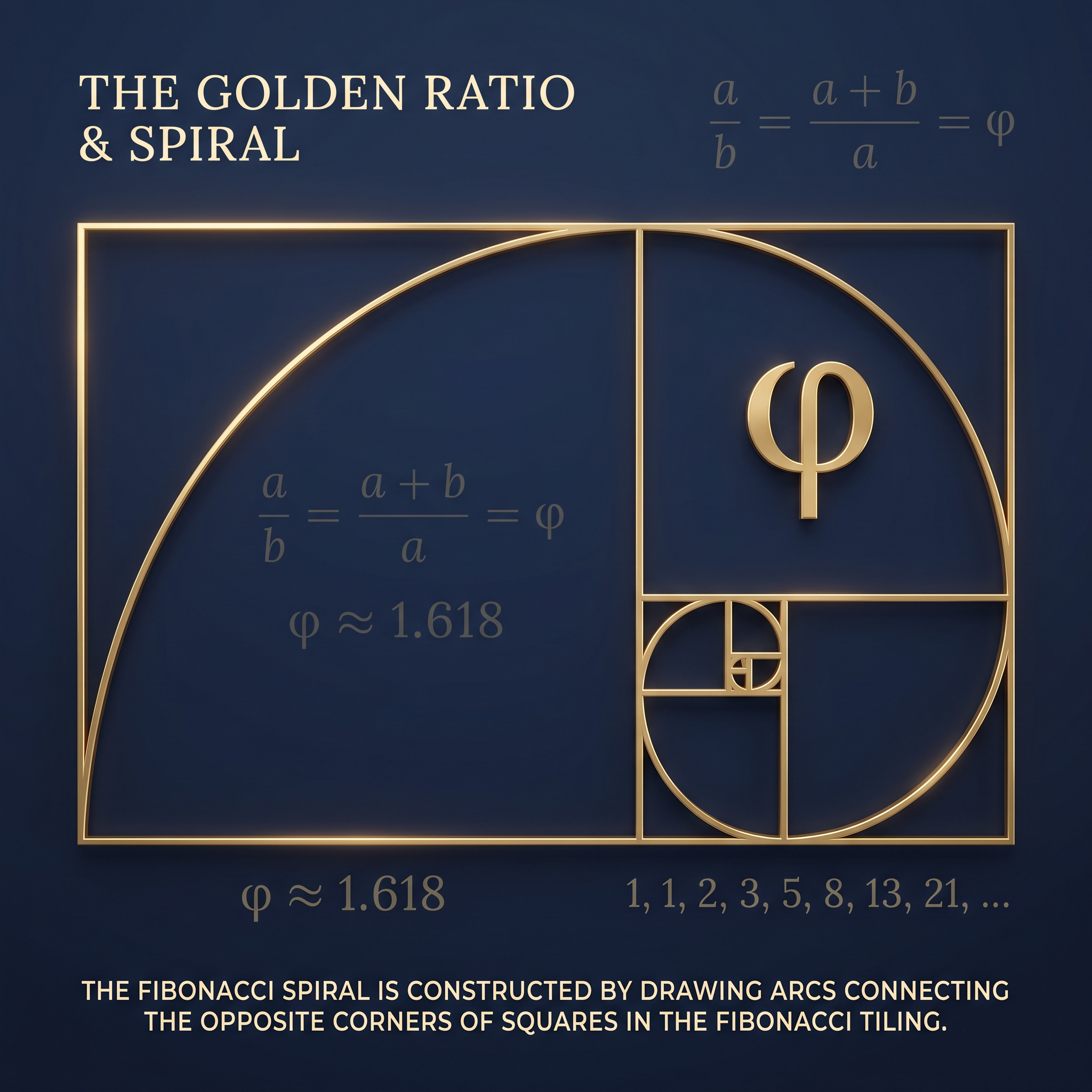
At its core, what is the golden ratio? It's an irrational number, approximately 1.61803398875, often denoted by the Greek letter φ (phi). Defined mathematically, the golden ratio describes the division of a line into two segments where the ratio of the whole line to the longer segment equals the ratio of the longer segment to the shorter one. In equation form: (a + b) / a = a / b = φ ≈ 1.618.
This self-similar property creates infinite nesting—zoom in, and the pattern repeats. Nicknamed the divine proportion for its aesthetic purity, phi embodies mathematical harmony. It's not just numbers; it's the visual rhythm that makes a composition feel right. Architects sense it in soaring arches; digital artists in pixel-perfect grids; typographers in baseline-to-cap height ratios.
Why does it matter for professionals like you? In a world of subjective taste, the golden ratio offers objective elegance. Studies in perception show audiences prefer phi-proportioned designs subconsciously—think enduring logos or monumental buildings that never age.
The Rich History of the Golden Ratio: From Ancient Greece to Renaissance Masters
Euclid and the Birth of Phi
The golden ratio's story begins around 300 BCE with Euclid in his Elements. He described it as the "extreme and mean ratio," a geometric construction from a circle and square. Ancient Greeks wove it into the Parthenon, where facade dimensions approximate φ, evoking divine balance amid marble perfection.
Medieval and Renaissance Revival
Fast-forward to the Renaissance: Luca Pacioli dubbed it the "divine proportion" in De Divina Proportione (1509), illustrated by Leonardo da Vinci. Da Vinci applied it in The Vitruvian Man, aligning human proportions to phi's cascade. Painters like Raphael and architects like Palladio embedded it in compositions and villas, chasing that mathematical harmony.
Modern Echoes in Design and Science
The 20th century saw Le Corbusier revive it via the Modulor system, scaling human-centric architecture to φ. Today, it's in everything from credit card dimensions to Twitter's tweet composer sidebar. This timeless thread proves: true professionals respect history's precision.
The Golden Ratio Formula and Fibonacci Sequence: The Math Behind the Magic
Golden Ratio Formula Explained
How to calculate the golden ratio? Start with the defining equation: Let a line of length a + b split so a > b, and (a + b)/a = a/b = φ. Solving yields φ = (1 + √5)/2 ≈ 1.61803398875. For practical use, multiply any length by φ for the next harmonious segment.
The inverse, 1/φ ≈ 0.618 (often called the golden conjugate), governs the smaller proportion—essential for nested layouts.
Fibonacci Sequence: Nature's Approximation of Phi
Enter the Fibonacci sequence: 0, 1, 1, 2, 3, 5, 8, 13, 21... Each number is the sum of the prior two. Divide consecutive terms (e.g., 21/13 ≈ 1.615), and ratios spiral toward φ. This Fibonacci sequence golden ratio link appears in sunflowers (spiraling seeds), pinecones, and nautilus shells—nature's blueprint for efficiency and beauty.
- Generate Fibonacci numbers: F(n) = F(n-1) + F(n-2)
- Compute ratio: F(n+1)/F(n)
- Observe convergence to 1.618 as n grows
Pro tip: Use Fibonacci for responsive design breakpoints—scales feel organic, never arbitrary.
Golden Ratio in Art: Timeless Principles for Digital Artists
Golden ratio in art isn't myth—it's measurable mastery. Da Vinci's Mona Lisa smile-to-chin height nears φ; Seurat's pointillism dots cluster in spirals. Contemporary digital artists overlay phi grids in Photoshop or Figma for focal points that draw the eye effortlessly.
- Composition: Place subjects at phi intersections, not rigid thirds.
- Spirals: Golden spiral (phi-scaled quarter-circles) guides viewer flow.
- Scaling: Element sizes multiply by φ for depth.
The golden ratio turns chaos into symphony—your next NFT or editorial illustration awaits its touch.
Golden Ratio Design Applications: Architecture, Typography, and UI Precision
Architecture and Golden Ratio Design
From the Pyramids' slopes to the UN Secretariat's curves, phi proportions human scale. Modern firms like Zaha Hadid Architects nod to it in fluid forms. For your projects: Facade widths to heights, window placements—φ ensures monumental yet inviting spaces.
Typography Enthusiasts' Secret Weapon
In typesetting, golden ratio governs hierarchy. Set body text x-height, multiply by φ for headings; line lengths at 0.618 of page width prevent fatigue. Tools like Adobe InDesign plugins automate this mathematical harmony.
UI/UX and Digital Precision
Apple's logo? Phi-proportioned. Google's Material Design? Fibonacci grids. Implement golden ratio design in Figma: Sidebar-to-content = φ; button heights cascade accordingly. Result? Interfaces that feel intuitive.
How to Calculate and Apply the Golden Ratio: Your Professional Toolkit
How to calculate golden ratio precisely? Skip mental math—use GetRatioGolden's free on-site Golden Ratio calculator. Input any dimension; get phi-scaled outputs, Fibonacci sequences, spirals, and grids instantly. Export SVGs for Adobe Suite or CAD software.
- Enter base length (e.g., canvas width).
- Select mode: Rectangle, spiral, typography.
- Generate overlays—drag into your canvas.
- Iterate with φ multiples for perfection.
For architects: Scale elevations. Typographers: Font cascades. Artists: Dynamic compositions. This tool embodies professional precision, saving hours while elevating craft.
Embrace Mathematical Harmony: Your Next Project Starts Here
The golden ratio isn't a trend—it's the universe's code for beauty, etched in galaxies and your greatest work. From phi 1.618's formula to Fibonacci whispers in leaves, it demands respect from discerning creators. Dive deeper with GetRatioGolden: Bookmark our Golden Ratio calculator, experiment fearlessly, and watch harmony unfold.
What design will you transform first? The divine proportion awaits.
