
What Is the Golden Ratio? The Ultimate Beginner's Guide to Phi (φ = 1.618)
Have you ever stared at a sunset, a seashell, or even a stunning building and thought, "This just feels right"? That inexplicable pull toward beauty, that sense of perfect harmony—it's no accident. Designers, architects, artists, and math lovers have chased this sensation for millennia. At its heart lies the golden ratio, a simple number called Phi (φ = 1.6180339887...) that unlocks the secret to proportions that captivate the eye and soothe the soul. This golden ratio explained guide will demystify it all, from its math to its magic in nature, art, and your next design project. By the end, you'll spot Phi everywhere—and wield it like a pro.
Defining the Golden Ratio: Phi and the Divine Proportion
What is the golden ratio? Picture two lengths, a shorter one (b) and a longer one (a), where the whole length (a + b) divided by the longer part (a) equals the longer part divided by the shorter (b). That magical constant? It's Phi, approximately 1.618. This self-similar ratio, where the parts mirror the whole, is why it's dubbed the divine proportion or golden mean.
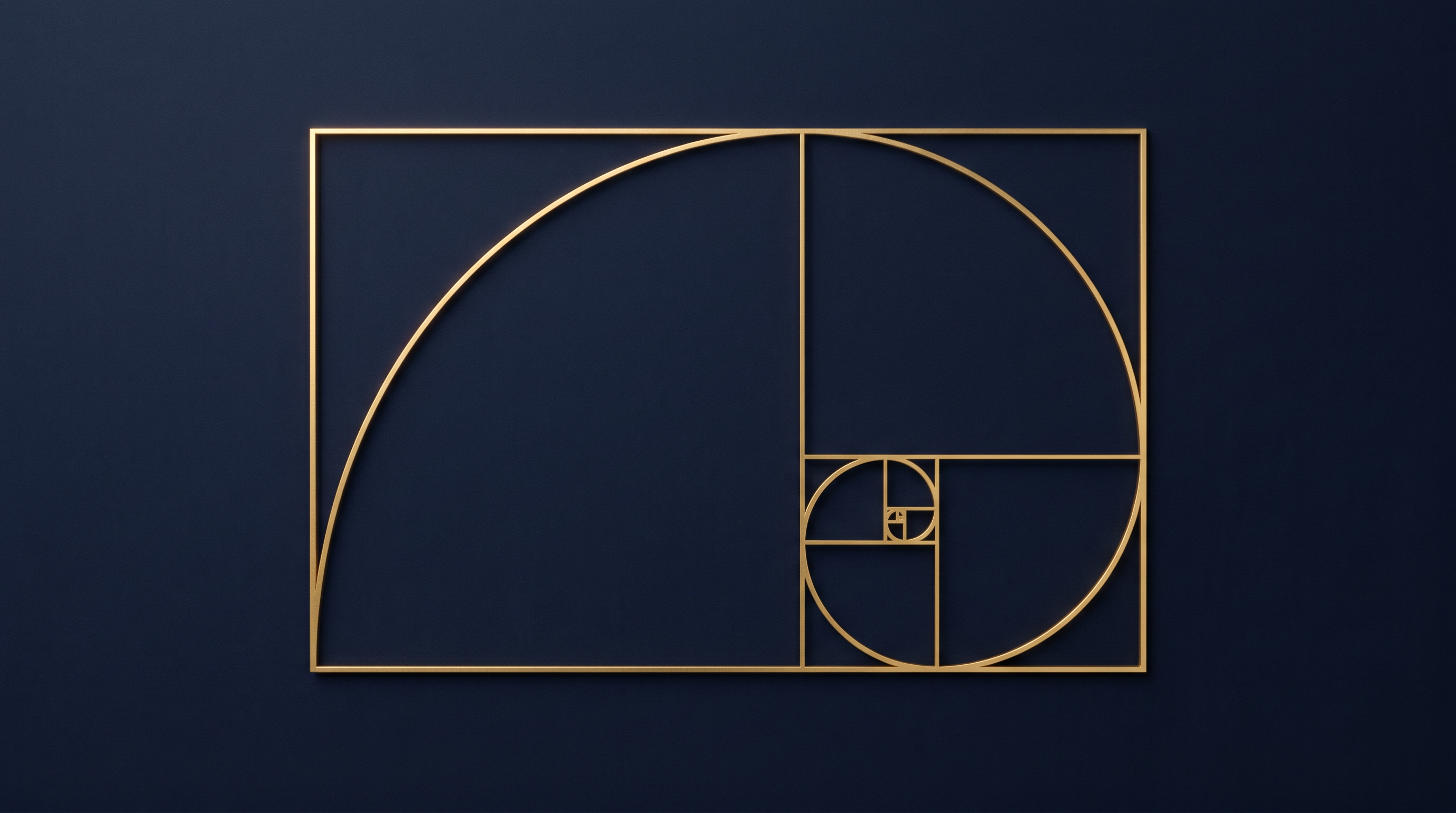
Unlike arbitrary rules, Phi emerges naturally, creating endless harmony. Remove the smaller square from a golden rectangle, and what's left is... another golden rectangle. It's infinite beauty in finite form, whispering that true elegance scales forever.
The Simple Math Behind the Golden Ratio
Forget dusty textbooks—here's the golden ratio formula in plain English: (a + b) / a = a / b = φ (1.618). Start with any two numbers where the bigger is 1.618 times the smaller. Scale up or down, and the beauty persists.
Why does this matter? It's the ultimate design proportion. In a logo, divide your canvas by Phi, and elements nest perfectly. No calculator needed once you grasp it—your eye learns to feel it.
- Practical tip: For a 1000px width, height = 1000 / 1.618 ≈ 618px. Boom—golden rectangle.
- Deeper dive: φ² = φ + 1. Square Phi, add 1, get Phi squared. Mind-bending recursion!
A Brief History of the Golden Ratio
From Ancient Greece to the Renaissance
Euclid nailed it around 300 BCE in his Elements: "A line segment divided so the whole to the larger equals the larger to the smaller." No name yet—just pure geometry.
Fast-forward to the Renaissance. Luca Pacioli's 1509 book Divina Proportione, illustrated by Leonardo da Vinci, crowned it the divine proportion. Da Vinci wove Phi into The Vitruvian Man and Mona Lisa, chasing nature's code. By 1838, Martin Ohm dubbed it the golden ratio—and the world was hooked.
Today, it's the phi ratio's turn in digital design, from apps to architecture.
Geometry of Beauty: Golden Rectangles and Spirals
Building the Golden Rectangle
Draw a 1x1 square. Attach a 1x0.618 rectangle (1/φ). You've got a golden rectangle. Slice off the square—repeat. Each step births another, spiraling inward eternally.
Enter the Golden Spiral
Connect the squares' corners with quarter-circle arcs. Voilà—the golden spiral, echoing hurricanes and galaxies. Architects love it for facades; artists for compositions that draw the eye inexorably deeper.
Imagine sketching your next poster: Align text blocks to this spiral, and viewers linger longer.
The Fibonacci Sequence and Phi
Leonardo Fibonacci introduced the sequence in 1202: Start with 0, 1, then add the last two: 0, 1, 1, 2, 3, 5, 8, 13, 21, 34, 55, 89, 144...
Divide consecutive numbers: 5/3 ≈ 1.667, 8/5 = 1.6, 13/8 = 1.625, 21/13 ≈ 1.615. Closer and closer to φ = 1.618. The Fibonacci sequence approximates the golden ratio, fueling sunflowers and stock charts alike.
- Sunflower seeds spiral in Fibonacci counts (34, 55, 89) for max packing.
- Design hack: Use Fibonacci grids for web layouts—responsive magic.
Golden Ratio vs. Rule of Thirds: Proportions Showdown
The rule of thirds grids your canvas into nine boxes, placing key elements at intersections (1:0.666 ratio). Quick, effective—but static.
The golden ratio? Dynamic. Its 1:0.618 flows organically, guiding the eye in a spiral dance. Thirds is beginner-friendly; Phi is the pro version for architects crafting cathedrals or designers perfecting UIs. Use both: Thirds for snapshots, golden for timeless impact.
Golden Ratio in the Real World: Nature, Art, and Design
Nature's Masterpiece
Nautilus shells approximate golden spirals, as do pinecones, hurricanes, and spiral galaxies like the Milky Way. Plant leaves (phyllotaxis) angle at 137.5°—the golden angle—for optimal sunlight. It's evolution's shortcut to efficiency.
Art and Architecture Classics
- Parthenon: Facade dimensions hover near 1.618.
- Great Pyramid of Giza: Base-to-height ratio teases Phi.
- Da Vinci's Last Supper: Composition windows divide by golden sections.
Modern Design Proportions
Apple's logo curves nod to Phi. Web designers grid hero images at 1:1.618. Typography? Leading and margins follow Fibonacci sequence for airy readability. Twitter's bird, Pepsi's swirl—Phi lurks in brand gold.
The Psychology of Phi: Why It Feels So Good
Enter processing fluency: Our brains zip through familiar patterns. Phi's recursion mirrors neural wiring, making it process faster—thus more beautiful. Studies show golden ratio faces rate higher; ads with Phi boost engagement 20-30%. It's not magic; it's your mind saying, "Yes, this feels right."
In a world of chaos, Phi offers order—subtle, infinite, human-scale order.
Debunking Golden Ratio Myths
Myth: Phi rules everything in nature. Truth: It's approximations, not perfection. Nautilus shells? Close, but log spirals vary. Human bodies? Proportions average around 1.6, but outliers abound. The golden ratio inspires, doesn't dictate—use it as a guide, not gospel.
Another: The Mona Lisa is exactly Phi. Nope—Da Vinci approximated masterfully. Embrace the spirit.
Your Practical Tool: Calculate Phi Instantly
Ditch the math. Head to GetRatioGolden.com—the pro calculator for designers. Input dimensions, get golden tweaks for layouts, logos, even architecture sketches. Gold-standard precision, navy-cool interface. Instant phi ratio harmony.
Spot Phi Everywhere: Your Golden Challenge
You've decoded the golden ratio explained, from Fibonacci sequence to divine designs. Now, step outside: Trace a fern's fronds, audit your favorite app, redesign your portfolio. Phi isn't elite math—it's your toolkit for beauty that endures.
Architects, etch it in stone. Artists, paint it alive. Designers, code it fluid. The universe hums at 1.618—join the symphony. What will you create first?
