
How to Calculate the Golden Ratio: Formula, Phi Math, Examples & Golden Rectangle Dimensions
Why the Golden Ratio Captivates Designers and Architects
Imagine scrolling through a website where every element aligns in perfect harmony, or sketching a facade that echoes the timeless balance of ancient wonders. This isn't mere luck—it's the subtle power of the golden ratio, a mathematical principle that has whispered through nature, art, and architecture for millennia. As a professional designer, architect, digital artist, or typography enthusiast, you know the thrill of proportions that feel right. The golden ratio, denoted by the Greek letter phi (φ) and approximately 1.618, delivers that elusive mathematical harmony.
From the spiral of a nautilus shell to the layout of the Parthenon, φ governs aesthetically pleasing divisions. In modern practice, it's your toolkit for crafting layouts, logos, and type scales that draw the eye effortlessly. But how do you harness it precisely? This guide demystifies how to calculate the golden ratio, breaks down the golden ratio formula, and equips you with step-by-step phi calculations for real-world design challenges. Whether you're sizing a canvas or perfecting golden rectangle dimensions, you'll leave with actionable golden ratio math.
The Golden Ratio Formula Explained
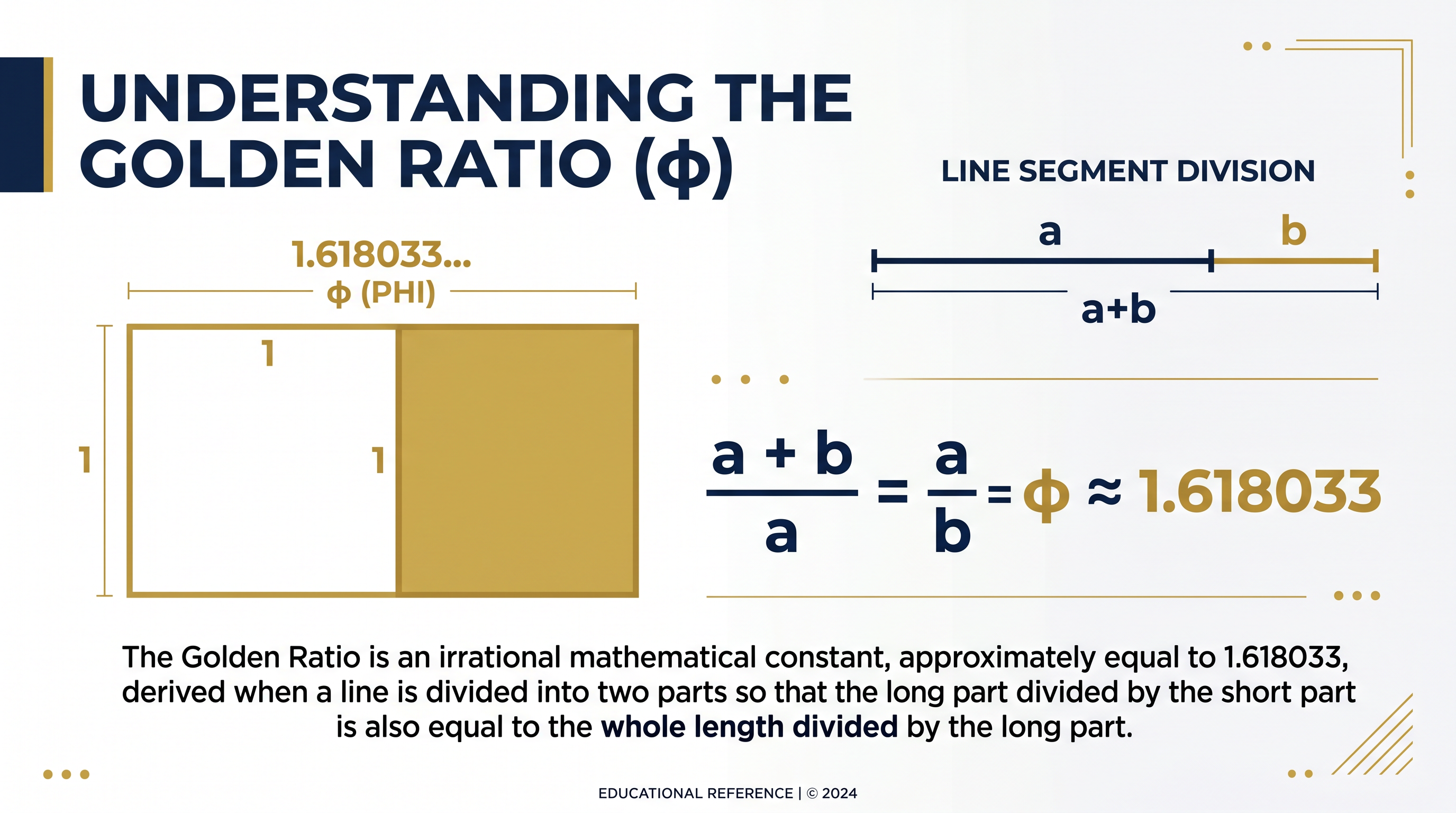
At its core, the golden ratio formula defines a relationship between two segments: a longer one (a) and a shorter one (b), where a > b. The magic happens when:
a / b = (a + b) / a = φ ≈ 1.61803398875
This self-similar property means the whole divided by the larger part equals the larger part divided by the smaller. It's infinite in its elegance—remove the square from a golden rectangle, and what's left is another golden rectangle. Phi (φ) is the irrational number (1 + √5)/2, but for practical golden ratio math, we use 1.618 as a working approximation, dialing up precision as needed.
Visualize it: Start with line segment a + b. The ratio holds eternally, making it ideal for scalable designs.
How to Find the Golden Ratio of Any Number: Step-by-Step
Need to calculate the golden ratio from one number? It's simple multiplication or division by φ. Decide if your starting number is the shorter (b) or longer (a) side.
If Starting with Shorter Side (b):
- Multiply b by φ (1.61803398875) to get a.
- Verify: a / b should ≈ 1.618.
If Starting with Longer Side (a):
- Divide a by φ to get b.
- Verify: (a + b) / a should ≈ 1.618.
Pro tip: Use more decimal places (e.g., 1.618034) for pixel-perfect work in tools like Adobe Illustrator or Figma.
Detailed Worked Examples of Golden Ratio Calculations
Let's apply this with concrete numbers. We'll use φ = 1.618034 for consistency.
Example 1: 100px Shorter Side
a = 100 × 1.618034 = 161.8034px. Ratio check: 161.8034 / 100 = 1.618034. Perfect for a button height-to-width.
Example 2: 50cm Longer Side
b = 50 / 1.618034 ≈ 30.9017cm. Total: 80.9017cm. Check: (50 + 30.9017) / 50 ≈ 1.618034. Ideal for poster dimensions.
Example 3: 144px (Fibonacci Nod)
b = 144 / 1.618034 ≈ 89.000px (exact in Fibonacci limits). Echoes nature's sequence.
Example 4: 800px Longer Side
b = 800 / 1.618034 ≈ 494.425px. Check: (800 + 494.425) / 800 ≈ 1.61803.
Mastering Golden Rectangle Dimensions
A golden rectangle has sides in φ ratio. To calculate golden rectangle dimensions:
- Choose width (longer: a) or height (shorter: b).
- Compute the pair as above.
- Scale infinitely: Subtract b × b square from rectangle; remainder is another golden rectangle.
For a 1200px-wide canvas: Height = 1200 / 1.618034 ≈ 741.61px. This nests spirals for dynamic compositions in digital art.
How to Verify if Two Numbers Are in Golden Ratio
Got existing dimensions? Test the relationship check:
- Assume larger (a), smaller (b).
- Compute a / b. Is it ≈1.618?
- Or (a + b) / a ≈1.618?
- Difference under 0.1%? It's golden.
Example: 55 and 34 (Fibonacci). 55/34 ≈1.6176—close enough for most designs.
Practical Design Example: Golden Grid for a 1000px Layout
You're building a 1000px-wide hero section. Set width as a=1000px, height b=1000/1.618034≈618.034px.
- Primary grid: 618px content block + 382px sidebar (618/382≈1.618).
- Typography scale: H1=72px, body=72/1.618≈44.5px.
- Next level: Sidebar subdivides to 236px + 146px images.
This creates a flowing, intuitive hierarchy that guides users naturally.
Common Mistakes to Avoid in Golden Ratio Math
- Rounding too early: 1.62 yields 5-10% errors over scales. Stick to 1.618034.
- Confusing a and b: Always longer first in ratios.
- Ignoring scalability: Test at multiple breakpoints.
- Over-relying on Fibonacci: Approximations, not exact φ.
Efficiency Tip: Leverage the GetRatioGolden Online Calculator
For lightning-fast precision in client pitches or iterations, the GetRatioGolden online calculator handles infinite decimals, batch computations, and exports. Input one number, select role (a or b), and get verified pairs instantly—saving hours on complex grids while ensuring professional accuracy.
Embrace Phi for Naturally Pleasing Designs
Mastering how to calculate the golden ratio isn't just math—it's unlocking designs that resonate on a primal level. From typography rhythms to architectural elevations, φ infuses your work with organic grace. Experiment today: Take a current project, apply these steps, and watch elements align like stars. Your audience will feel the harmony, even if they can't name it. Dive into golden ratio math, and let proportion elevate your craft.
