
Golden Ratio Web Design: Mastering Phi Layouts, Typography & CSS for Divine Proportions
Why Some Websites Whisper Harmony While Others Scream Chaos
Imagine landing on a website where every element aligns effortlessly—your eye glides from hero image to call-to-action without friction. Now contrast that with a cluttered page where buttons clash and text fights for air. That subtle difference? It's often the divine proportion at work, the golden ratio known as Phi (φ ≈ 1.618). This ancient mathematical constant, born from the Fibonacci sequence, has shaped masterpieces from the Parthenon to Leonardo da Vinci's Vitruvian Man. In golden ratio web design, it transforms pixel-pushing into mathematical harmony, creating layouts that feel intuitively right.
Designers and developers chase this elusive 'rightness' because our brains crave balance. Studies in visual perception show asymmetrical harmony—rooted in Phi—reduces cognitive load, boosting engagement by up to 20%. Enter phi layouts: not rigid grids, but fluid proportions that scale across devices. This guide dives deep into applying Phi for layouts, typography, spacing, and CSS, arming you with practical tools for divine proportion web design.
Crafting Phi Layouts: Divide and Conquer with 1.618
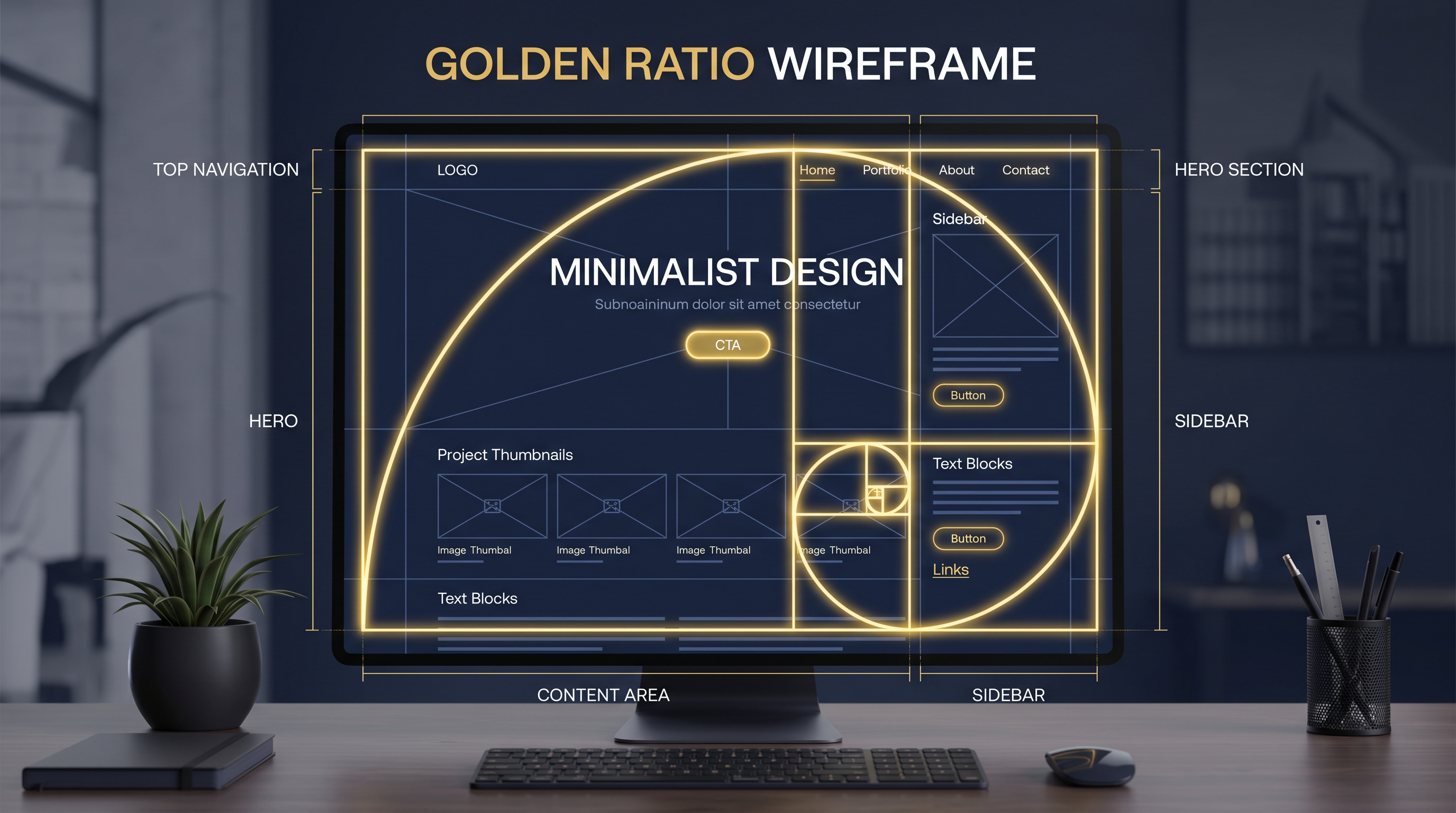
The core of golden ratio web design lies in sectioning pages using Phi's self-similar ratio. Take a full-width container (say, 1200px). Divide it: primary content claims 100% / φ ≈ 61.8%, leaving the sidebar at 38.2% (the complementary ratio, 1/φ). This phi layout mirrors nature's spirals, guiding the eye naturally from content to navigation.
Hero Sections and Beyond
For hero heights, skip arbitrary 400px guesses. Use viewport height divided by Phi: height: calc(100vh / 1.618);. This yields ~61.8% screen height, perfect for immersive visuals without overwhelming scrolls. Cascade downward: secondary sections at hero height / φ, creating a diminishing spiral of focus.
Consider a blog layout. Main content: 61.8% width. Sidebar: 38.2%. Nested cards within content follow suit—headline image at 61.8%, text block at 38.2%. This recursive application ensures design proportions that breathe, avoiding the boxy feel of equal columns.
.container {Golden Ratio Typography: Scaling Font Sizes for Visual Hierarchy
Typography isn't guesswork—it's web design math. Build a modular scale where each heading size multiplies the base by φ. Start with body text at 16px (1rem). H6: 16px. H5: 16 × 1.618 ≈ 26px. H4: 26 × 1.618 ≈ 42px. Up to H1: ~100px. This golden ratio typography creates effortless hierarchy, where sizes feel proportional, not arbitrary.
Line Height and Rhythm Mastery
Optimize line heights similarly: body line-height: 1.618 (loose, readable). Headings: 1.25 to 1.618 for punch. Paragraphs sing at 1.618rem relative to font-size, ensuring descenders and ascenders dance without crowding. Test it: a Phi-scaled article reads faster, eyes flowing like a gentle wave.
- H1: 1.618⁴ × base ≈ 110px
- H2: 1.618³ × base ≈ 68px
- H3: 1.618² × base ≈ 42px
- Body: 16px, line-height: 1.618
Pro Tip:
Use CSS custom properties for scales: --phi: 1.618; then font-size: calc(var(--base) * var(--phi, 1));. Recalculate on resize for true fluidity.
White Space Magic: Fibonacci Padding and Margins
Blank space isn't empty—it's the canvas for divine proportion web design. Leverage the Fibonacci sequence (1, 1, 2, 3, 5, 8, 13...), which converges on Phi. Assign paddings: xs: 0.5rem (≈5px), s: 0.8rem (8px), m: 1.3rem (13px), l: 2.1rem (21px).
Vertical rhythm: section margin-bottom: 3.2rem (Fib 34px scaled). Card padding: top/bottom 1.618rem, sides 1rem. This creates breathing room that scales, preventing cramped mobile views or cavernous desktops.
- Base unit: 8px (Fib 8)
- Scale up: 13px, 21px, 34px
- Apply: padding: 1.618rem 1rem;
Real-World Echoes of Phi in Iconic Sites
Legacy Twitter's feed exemplified phi layouts: tweet content at ~61.8% width, interactions sidebar-complement. National Geographic's homepage deploys hero images at golden sections, spirals drawing eyes to exploration CTAs. These aren't accidents—subtle Phi use elevates user dwell time, proving golden ratio websites convert quietly.
Responsive Design: Proportions Trump Pixels
Fixed pixels shatter on mobile; ratios endure. In css golden ratio, use em/rem clamped with calc(): font-size: clamp(1rem, 4vw * 1.618, 2rem);. Layouts reflow: @media (max-width: 768px) { .main { width: 100%; } sidebar hidden, content expands harmoniously. Phi ensures fluidity—no reflow jank, just elegant adaptation.
CSS in Action: Calc Formulas for Phi Precision
Modern CSS makes golden ratio web design trivial. Define --phi: 1.618; in :root. Deploy everywhere:
:root {
  --phi: 1.618;
  --base-font: 16px;
}

.hero {
  height: calc(100vh / var(--phi));
  padding: calc(var(--base-font) * var(--phi)) var(--base-font);
}

.grid {
  display: grid;
  grid-template-columns: 1fr calc(1fr / var(--phi));
}
Nest spirals: .cta { position based on golden rectangle intersections. } Test in DevTools—watch harmony emerge.
Golden Spiral Patterns: CTAs and Imagery That Captivate
Extend to patterns. Overlay a golden spiral on your canvas: place primary CTA at the smallest quarter's end. Images crop to 1:1.618 rectangles. Overlays follow arc curves for focal points. This phi layout variant turns static pages into dynamic journeys, eyes spiraling inward to conversions.
Tool Spotlight: GetRatioGolden for Instant Phi Values
Skip manual math with GetRatioGolden. Input base size; it spits Fibonacci/Phi scales for fonts, spacings, layouts. Export CSS vars or SVG overlays. Perfect for rapid prototyping—plug in 16px base, harvest H1 at 110px, margins at 34px. Designers swear by it for pixel-perfect design proportions.
In the tool's grid, watch ratios bloom—pure mathematical harmony at your fingertips.
Embrace the Divine: Phi as Your Design North Star
Golden ratio web design isn't a trend—it's timeless truth. From golden ratio typography that reads like poetry to phi layouts that scale eternally, Phi infuses your work with divine proportion. Ditch the gridlock; code with calc() conviction. Your sites won't just function—they'll resonate. Next project: measure twice, Phi once. The universe approves.
