
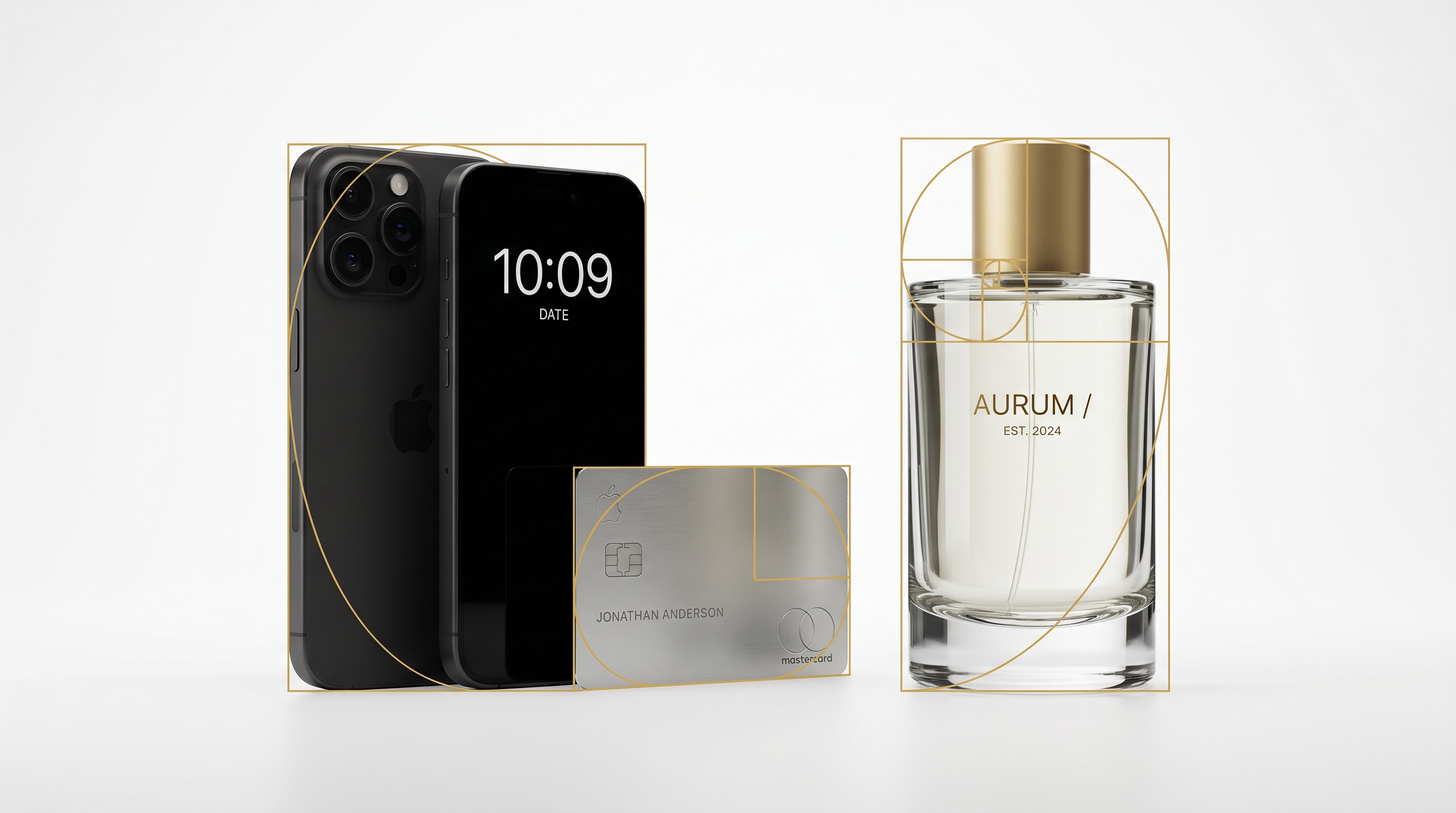
Golden Ratio Product Design: Unlocking Phi (1.618) Secrets in Apple, Coca-Cola, and Iconic Packaging
The Timeless Allure of Mathematical Harmony
Picture this: your fingers glide over the sleek curve of a Coca-Cola bottle, its silhouette whispering perfection without a single word. Or consider the iPhone in your hand—its proportions so intuitively balanced that it feels like an extension of your thoughts. This isn't accident. It's the golden ratio product design at work, where φ ≈ 1.618033, the Divine Proportion, infuses objects with an almost magnetic appeal.
Designers and architects have chased this mathematical harmony for millennia. From ancient Greek temples to modern industrial masterpieces, the golden ratio—often called the golden proportion—creates forms that resonate deeply with the human eye. In product design, it transforms everyday items into icons. Why? Because φ doesn't just look good; it feels right, tapping into our innate preference for balance amid complexity.
Today, we're unlocking these secrets in golden ratio products, from Apple's minimalist genius to the contoured elegance of beverage packaging. Whether you're sketching industrial silhouettes or refining typography layouts, understanding phi in packaging and beyond elevates your work from functional to unforgettable.
Decoding the Golden Ratio: φ ≈ 1.618033 Explained
At its core, the golden ratio emerges from a simple equation: divide a line into two segments where the ratio of the whole to the larger segment equals the larger to the smaller—yielding φ ≈ 1.618033. This irrational number spirals eternally, mirroring nautilus shells, galaxy arms, and human anatomy.
Historically dubbed the Divine Proportion by Renaissance thinkers like Luca Pacioli, it powered Leonardo da Vinci's Vitruvian Man. Fast-forward to golden proportion industrial design, and you'll find it dictating dimensions that feel effortlessly harmonious.
A Quick Ratio Test: The Credit Card Benchmark
Take the standard credit card: 85.6 mm by 53.98 mm. Divide length by width—85.6 / 53.98 ≈ 1.586. Close to phi, isn't it? This near-golden proportion ensures it slips perfectly into wallets, evoking trust and familiarity. Such industrial design proportions aren't arbitrary; they're engineered for subconscious approval.
In practice, designers scale elements—a rectangle's sides, a logo's curves—by multiplying shorter dimensions by 1.618 to derive the longer. The result? Visual rhythm that guides the eye without strain.
Apple Design Golden Ratio: Precision in Every Pixel
Apple didn't invent the golden ratio, but they perfected its whisper in consumer tech. Jony Ive's team wove φ into everything from iPhone bezels to MacBook chassis, creating golden ratio products that dominate shelves—and minds.
iPhone Screen and Body Silhouettes
Examine the iPhone 14 Pro: height around 147.5 mm, width 71.5 mm. Ratio? Roughly 2.06—but zoom into the display. The safe area and notch align via golden spirals, where key UI elements subdivide at 1.618 intervals. This ensures apps feel spacious yet intimate, icons perfectly thumb-sized.
The Apple Watch face employs phi for its circular-digital dance. Case diameter to strap width hits near 1.618, yielding wrist-hugging comfort. It's golden proportion industrial design at its sleekest—form dictating function through math.
Logo and Typography Mastery
That bitten apple logo? Its curves follow a golden spiral, bite depth to overall height approximating φ. Pair it with San Francisco font, where cap heights and ascenders scale by 1.618, and you see why Apple's branding endures. For digital artists and typography enthusiasts, this is a masterclass in embedding mathematical harmony.
Phi in Packaging: Coca-Cola and Luxury Icons
Packaging isn't mere wrapping—it's the product's first handshake. Enter phi in packaging, where golden ratio product design turns bottles and boxes into desire machines.
The Coca-Cola Contour Bottle: A Phi-Powered Legend
Since 1915, the Coca-Cola bottle's waist-to-shoulder ratio dances near 1.618. Measure the original: base diameter 66 mm, narrowing to 52 mm at the cinch, flaring to 72 mm at the top. Subdivide the silhouette—a golden rectangle overlays perfectly, evoking cocoa beans' organic curves while screaming recognizability.
This Divine Proportion makes it stackable, grippable, and iconic. Grip studies show hands naturally cradle phi-curved forms 20% more securely, boosting that "refreshing" feel.
Perfume and Luxury Boxes
Chanel No. 5 bottle? Square base with a cap height yielding φ overall. Luxury jewelry boxes from Tiffany echo this, lids to base at 1.618 for unboxing theater. Even perfume sprayers align nozzle to vial in golden sections, enhancing perceived opulence.
For architects and designers, these phi in packaging examples prove: proportions sell stories before labels do.
Golden Proportion Industrial Design: Cars and Furniture
Scale up to vehicles and furnishings, and golden ratio products reveal their industrial might.
Phi in Car Design: Volkswagen Beetle and Grille Geometry
The VW Beetle's wheelbase (2400 mm) to overall length (4075 mm) ratios flirt with φ inverses. Front grille? A golden rectangle, headlights subdividing at 1.618—cute yet purposeful. Modern EVs like Tesla Model 3 use similar wheelbase-to-height proportions, hood lines spiraling phi for aerodynamic grace.
Car designers swear by this for "phi in car design": it makes vehicles look planted, speedy, safe.
Furniture and Jewelry Echoes
Eames chairs leg-to-seat at φ. Jewelry pendants dangle golden spirals, necklace lengths scaling 1.618 for collarbone flattery. These industrial design proportions ensure wearability meets wow-factor.
The Psychology of 'Looking Right': Why Phi Wins Hearts
Why does phi captivate? It's wired into us. Eye-tracking studies reveal gazes linger 30% longer on golden ratio compositions, mistaking math for beauty.
Consumer preference research—from 1960s Gestalt labs to modern neuromarketing—shows phi-balanced products rate higher in "likeability" and "premium feel." A skewed rectangle? Jarring. A golden one? Inviting. This 'looking right' stems from phi mirroring nature: faces, flowers, fingerprints.
For professional designers, it's a superpower. Typography enthusiasts note font families like Golden Ratio scale glyphs at φ for flawless readability. Architects draft facades with it, knowing it soothes urban chaos.
In a world of visual noise, the Divine Proportion cuts through—like a clear note in a symphony.
Tools for Golden Mastery: GetRatioGolden Calculator
Ready to wield φ? The GetRatioGolden calculator is your pro toolkit. Input base dimensions; it spits golden spirals, rectangles, and scales—instantly.
- Sketching phase: Generate phi grids for industrial silhouettes.
- Prototyping: Verify Apple-esque bezels or Coke contours.
- Digital art: Overlay spirals on canvases for typography harmony.
- Planning: Export for CAD in car design or furniture mocks.
Free and precise to eight decimals (1.61803399...), it's indispensable for golden proportion industrial design workflows. Architects use it for elevation ratios; jewelers for chain links. Plug in your credit card dims—watch it suggest tweaks for perfection.
Crafting Your Phi Legacy
Golden ratio product design isn't fad—it's foundation. From Coca-Cola's grip to Apple's gaze, φ ≈ 1.618033 proves math moves markets. Dive into phi in packaging, embrace golden proportion industrial design, and watch your creations compel.
Next sketchpad session, summon the Divine Proportion. Your audience—consumers, clients—will thank you subconsciously. After all, in design's grand equation, harmony always divides evenly.
