
Golden Ratio in the Human Body: Phi (1.618) Reveals Divine Proportions in Vitruvian Man and Beyond
The Innate Pull of Beauty: Where Art Meets Mathematics
Have you ever paused before a sculpture or portrait, struck by an inexplicable sense of harmony? That subtle allure, the naturally pleasing balance that draws the eye and stirs the soul, often traces back to a single, ancient number: φ ≈ 1.618033, the Golden Ratio. Known as the Divine Proportion, this irrational number weaves through nature's tapestry—from spiraling galaxies to sunflower seeds—and finds its most profound echo in the golden ratio human body.
For professional designers, artists, and anatomy enthusiasts, understanding phi in the body unlocks professional precision in creation. Our bodies aren't random assemblies; they embody mathematical harmony, proportions that Renaissance masters like Leonardo da Vinci immortalized. This isn't mere coincidence. It's a blueprint of beauty, etched into our very form, inviting us to explore how these ratios shape everything from limbs to DNA.
Vitruvian Man: Da Vinci's Blueprint of Divine Proportions
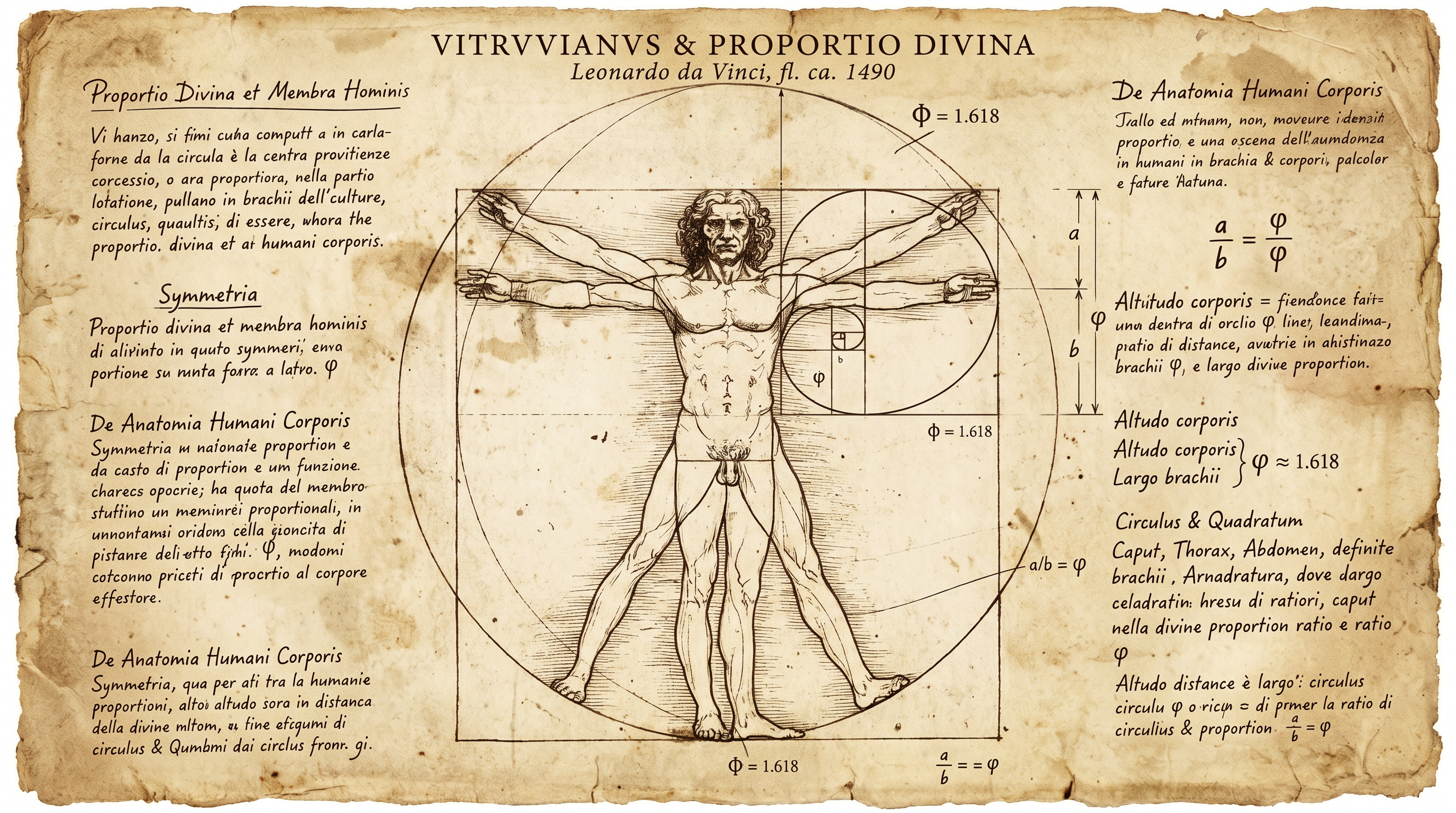
Picture Leonardo da Vinci in his Milanese workshop, quill in hand, sketching the ultimate human ideal: the Vitruvian Man. This iconic 1490 drawing overlays a man within a square and circle, symbolizing the union of earthly and divine measures. At its heart lies the Vitruvian Man golden ratio, drawn from Roman architect Vitruvius's ancient treatise on ideal proportions.
The navel serves as the pivotal focal point—the center of the circle, dividing the body such that the distance from feet to navel relates to navel to crown by φ ≈ 1.618033. Enclosed in the square, the figure's outstretched arms and legs align symmetrically, hinting at the human body proportions golden ratio. Da Vinci didn't invent these; he observed them in cadavers and live models, revealing how our anatomy approximates this Golden calculation. It's a visual symphony, where geometry breathes life into ink.
Macro Proportions: The Body's Grand Architectural Scale
Height and the Navel Divide
Step back to the full figure: in the ideal human form, total height H divides at the navel where the lower segment (navel to feet, approximately 0.618H) to the upper segment (head to navel, 0.382H) yields φ. More precisely, the ratio of total height to the height from feet to navel is φ ≈ 1.618033. This golden ratio human body macro structure mirrors classical architecture, like the Parthenon's facade.
Bilateral Symmetry in Motion
Extend this to shoulders: width often ratios to height in phi-like segments. These aren't rigid rules—human variation adds nuance—but they provide a scaffold for phi in the body, explaining why elongated figures in fashion or heroic statues feel inherently balanced. Measure yourself: from floor to navel, then navel up. The whisper of Divine Proportion emerges.
Limb Proportions: Fractal Echoes of Phi
The golden ratio fractalizes down the limbs, repeating at every scale like a self-similar Mandelbrot set. Consider the arm: fingertip to elbow versus wrist to elbow approximates φ, with the full arm (shoulder to fingertip) to upper arm (shoulder to elbow) echoing the same. Legs follow suit—hip to knee over knee to ankle nears 1.618.
- Upper arm (shoulder to elbow) : forearm (elbow to wrist) ≈ 1 : 0.618
- Full arm : upper arm ≈ φ ≈ 1.618033
- Thigh : lower leg mirrors this pattern
This recursive beauty in human body proportions golden ratio allows fluid, lifelike motion in animation or sculpture. Artists revel in it: a slight phi adjustment transforms a stiff sketch into dynamic grace.
The Human Hand: Fibonacci's Fingerprints
No limb captivates like the hand, a microcosm of phi. Phalange lengths ascend the Fibonacci sequence—proximal, middle, distal: roughly 5:3:2:1 ratios, converging on φ ≈ 1.618033. Palm to middle finger tip over palm to first knuckle? Golden again.
This isn't whimsy; it's evolutionary utility for grasping. For designers rendering hands—think Michelangelo's Creation of Adam—these ratios ensure naturally pleasing dexterity. Trace your own: the subtle curve from thumb to pinky pulses with mathematical harmony, a handcrafted ode to the Divine Proportion.
Facial Proportions: The Golden Mask of Attractiveness
Shift upward: the face dons a 'Golden Ratio Mask,' an overlay where eye width to nose base, or face height to width, hugs φ. Cheekbone to chin over forehead to cheekbone—phi reappears. While not universal, these phi in the body facial cues contribute to perceived beauty across cultures.
Photographers and portrait artists overlay grids, tweaking for that elusive balance. It's a quick nod to how golden ratio human body proportions elevate the mundane to mesmerizing.
Micro Proportions: Phi in the DNA Helix
Zoom to the molecular: the DNA double helix measures roughly 34 Ångstroms by 21 Ångstroms in key dimensions—Fibonacci numbers yielding φ ≈ 1.618033. Each helical turn spans 34 Å vertically over 10 base pairs, with width ratios echoing the sequence. This human body proportions golden ratio at the genetic core suggests life's code is proportioned for optimal packing and function.
From macro to micro, phi permeates, hinting at universal design principles in biology.
Evolutionary Psychology: Why Phi Captivates Us
Why do these ratios stir us? Evolutionary psychology posits phi-proportioned bodies signal health: bilateral symmetry indicates genetic fitness, robust immunity. Proportions deviating too far whisper developmental stress. Our brains, wired for pattern recognition, deem them naturally pleasing, triggering dopamine rewards.
In mate selection or art appreciation, this bias endures—a humanist lens on why beauty feels innate, fostering connection across humanity.
Scientific Validity and Ethical Caution
Perfection is a guide, not a cage—variation is the essence of life.
Studies confirm average ratios hover near phi, but biology thrives on diversity. No human is 'perfectly' golden; ideals like Vitruvian Man golden ratio are aspirations, not mandates. Caution against body dysmorphia: celebrate variation, use these for inspiration, not judgment. True beauty lies in individuality.
Practical Applications for Artists and Designers
Figure artists grid canvases with phi spirals, ensuring limbs cascade in harmony. Anatomists sketch skeletons overlaying golden rectangles. In digital tools, plugins snap proportions to φ ≈ 1.618033 for professional precision. Whether charcoal or CGI, these ratios breathe realism into the unreal.
Tool Integration: Measure Your Own Golden Proportions
Curious about your form? Plug measurements into the GetRatioGolden calculator. Input height, navel split, arm lengths—watch phi emerge or diverge. Designers, test logos or architecture; it's a gateway to Golden calculation mastery.
Mathematical Harmony: A Universal Human Legacy
From Da Vinci's gaze to your mirror, the golden ratio human body reveals a cosmos in flesh. Phi ≈ 1.618033 isn't imposed; it arises organically, a Divine Proportion binding us to nature's rhythm. Artists, wield it with care; enthusiasts, marvel at its depth. In this harmony, we glimpse the universe's elegant code—imperfectly perfect, profoundly human.
