
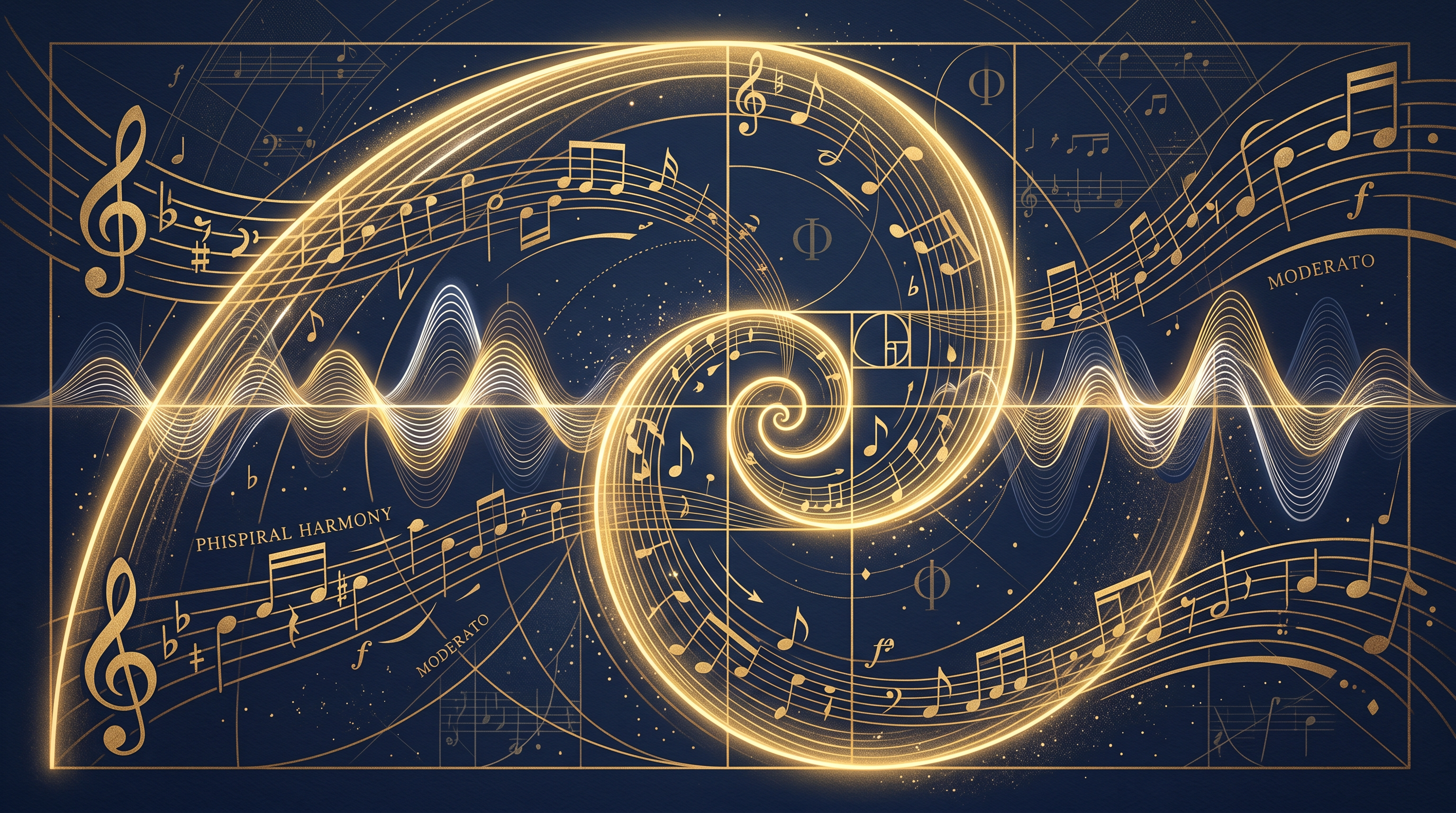
Golden Ratio in Music: Fibonacci Scales, Golden Climaxes, Tool's Lateralus & Production Secrets
Imagine crafting a track where every swell, every drop, every haunting melody feels inevitable—like the universe itself is humming along. That's the magic of the golden ratio in music, that ancient mathematical siren (φ ≈ 1.618) whispering secrets to composers and producers alike. Born from the Fibonacci sequence, where each number is the sum of the two preceding ones (1, 1, 2, 3, 5, 8, 13...), this ratio isn't just pretty patterns in nature. It's the hidden architecture behind spine-tingling climaxes and scales that resonate on a primal level. As a producer who's geeked out over waveforms and waveforms of data, I've seen how injecting phi in music production turns good songs into timeless anthems. Buckle up—this deep dive uncovers how math meets melody.
The Eternal Dance: Math and Music's Deep Connection
Music and mathematics? They're not distant cousins; they're twins separated at birth. Pythagoras knew it millennia ago, tuning strings to perfect fifths via simple ratios. Fast-forward to the golden ratio music phenomenon, and you see φ everywhere—from spiral galaxies to your DAW timeline.
Why does it work? Our brains crave balance. The golden ratio delivers asymmetry that's pleasingly off-kilter, mirroring nature's fractals. In music, it creates tension-release cycles that hook listeners subconsciously. Think of a bassline climbing Fibonacci steps: it pulls you forward without resolution until... boom, the payoff.
Producers, this is your cheat code. Overlay φ on your arrangement, and suddenly transitions snap into divine flow.
Fibonacci Sequence in Musical Scales: The 2-3-5-8 Revolution
Building Scales from Nature's Code
Standard major scales? Predictable. Enter Fibonacci sequence in musical scales: intervals of 2, 3, 5, 8 semitones from the root. Start on C: up 2 to D, +3 to F, +5 to C, +8 to Ab. Rinse and repeat for ethereal, otherworldly modes.
These aren't random. They approximate φ ratios, creating mathematical harmony music that evokes ancient modes like the Lydian scale but with fractal depth. Jazz cats and ambient wizards swear by them—try layering a Fib scale over pads for instant hypnosis.
- 2 semitones: Tense minor second, like a knife's edge.
- 3 semitones: Minor third, emotional core.
- 5 semitones: Perfect fourth gateway.
- 8 semitones: Minor sixth, golden stretch to resolution.
- 13 semitones: Octave plus whole tone, looping infinity.
Real-World Application
Patch it into your synth: Serum or Vital with Fib interval mapping. The result? Scales that breathe, evolving like a nautilus shell. Fans of mathematical art will geek out—it's phi sculpted in sound.
The Golden Moment in Songs: Climax at 61.8%
Here's the producer's holy grail: the golden moment in songs. Plot your track's length on a timeline. Mark 61.8% (φ inverse)—that's your climax sweet spot. Build tension before, explode here, resolve after. Listeners stay glued; drop-off rates plummet.
Why 61.8%? It's the point where the smaller segment to the whole equals the whole to the larger—pure proportion. Your verse-chorus-bridge? Time the peak vocal or drop precisely there.
Classical Giants Harnessing Phi: Debussy and Bartók
Debussy's La Mer: Waves of Golden Tension
Claude Debussy's La Mer (1905) is oceanic phi mastery. In the first movement, waves crest at the golden section—crescendos hit 61.8% through surging strings and brass, mimicking tidal inevitability. No coincidence; Debussy studied sacred geometry.
Bartók's Architectonic Precision
Béla Bartók embedded φ in Music for Strings, Percussion and Celesta. Movements divide goldenly: Sonata form peaks at 0.618 markers. His rhythms pulse Fib sequences, bridging folk roots with cosmic order. Architects and designers, note how this mirrors building facades.
Golden Climaxes in Pop and Rock: From Beatles to Beyond
Pop isn't immune. The Beatles' "A Day in the Life" (7:09 total): orchestral swell erupts at ~4:25, bang on 61.8%. That rising chaos? Pure golden moment.
Genesis' epic "Supper's Ready" (23 minutes): multi-suite climax in "Apocalypse in 9/8" hits golden ratios across sections. Modern? Radiohead's "Paranoid Android" layers tension to a 62% guitar freakout. Even Billie Eilish's "Bad Guy" drop teases phi timing in its build.
Kanye West's "Runaway" (9:40): piano outro resolves post-61.8% peak. These aren't accidents—intuitive hits or deliberate math fuel chart-toppers.
Tool's Lateralus: The Fibonacci Song Blueprint
Lyrics as Numeric Poetry
Tool Lateralus Fibonacci is legendary. Danny Carey's drum intro: 987 bpm (Fib numbers backward). Lyrics? Syllables spiral: "Black" (1), "then" (1), "white are" (2), "all I see" (3), "in my infancy" (5), "red and yellow then came green" (8), cycling back. Pure genius.
Time Signatures and Structure
Verses shift 9/8, 8/8, 7/8 (Fib descending). Bridge explodes in 13/8 nods. Whole track (~10 minutes) crescendos at golden section. Maynard James Keenan's "spiral out, keep going"? Literal phi manifesto. Prog fans and math nerds: dissect this in your next session.
Golden Ratio in Instrument Design: Stradivarius Secrets
Golden ratio instrument design elevates tone. Antonio Stradivarius violins (c.1700) feature bodies where plate lengths ratio to φ—f-holes, bridge placement all golden. Result? Unmatched resonance, warmth defying physics.
Acoustic guitars and chambers follow suit: speaker enclosures, guitar body outlines scaled to 1:1.618 for optimal vibration. Architects, apply to studio rooms—phi-proportioned walls kill standing waves, birthing mathematical harmony music.
Phi in Rhythm: Complex Time Signatures Unleashed
Rhythms crave phi too. Tool's 5/4 over 8/8 overlays Fib layers. King Crimson's "Fracture" pulses 7+5+13 beats. In production, quantize hi-hats to Fib divisions: 3+5+8 sixteenths for groove that swings eternally.
Electronic? IDM pioneers like Aphex Twin fractalize beats goldenly. Your next trap beat: drop at 13/8 into 8/5 polyrhythm. Dancers lock in subconsciously.
Production Hacks: Master GetRatioGolden's Calculator
Enter phi in music production: tools like GetRatioGolden (free online calc). Input song length (e.g., 3:30 = 210s). Boom: climax at 129.8s. Mark verse ends at 38.2% (1-φ), build to 61.8% drop, bridge at 76.4%.
- Load track in DAW timeline.
- Calc golden points.
- Place peaks: vocal ad-libs, synth risers, bass drops.
- Tweak transitions: 161.8% micro-ratios for fills.
- A/B test—watch engagement soar.
EDM drops? Time builds to φ. Hip-hop bridges? Enter at golden gate. This is how pros like Deadmau5 or Finneas edge the competition.
The Symphony of Mathematical Harmony
From Fibonacci scales to Lateralus spirals, the golden ratio in music proves art and math are one. It's not rigid rules—it's a lens sharpening intuition. Musicians, producers, designers: next session, draw the spiral. Watch your work transcend.
In a chaotic world, phi offers order that feels free. Spiral out. Keep going.
