
Golden Ratio in Interior Design: The Ultimate Guide to Perfect Proportions and Timeless Harmony
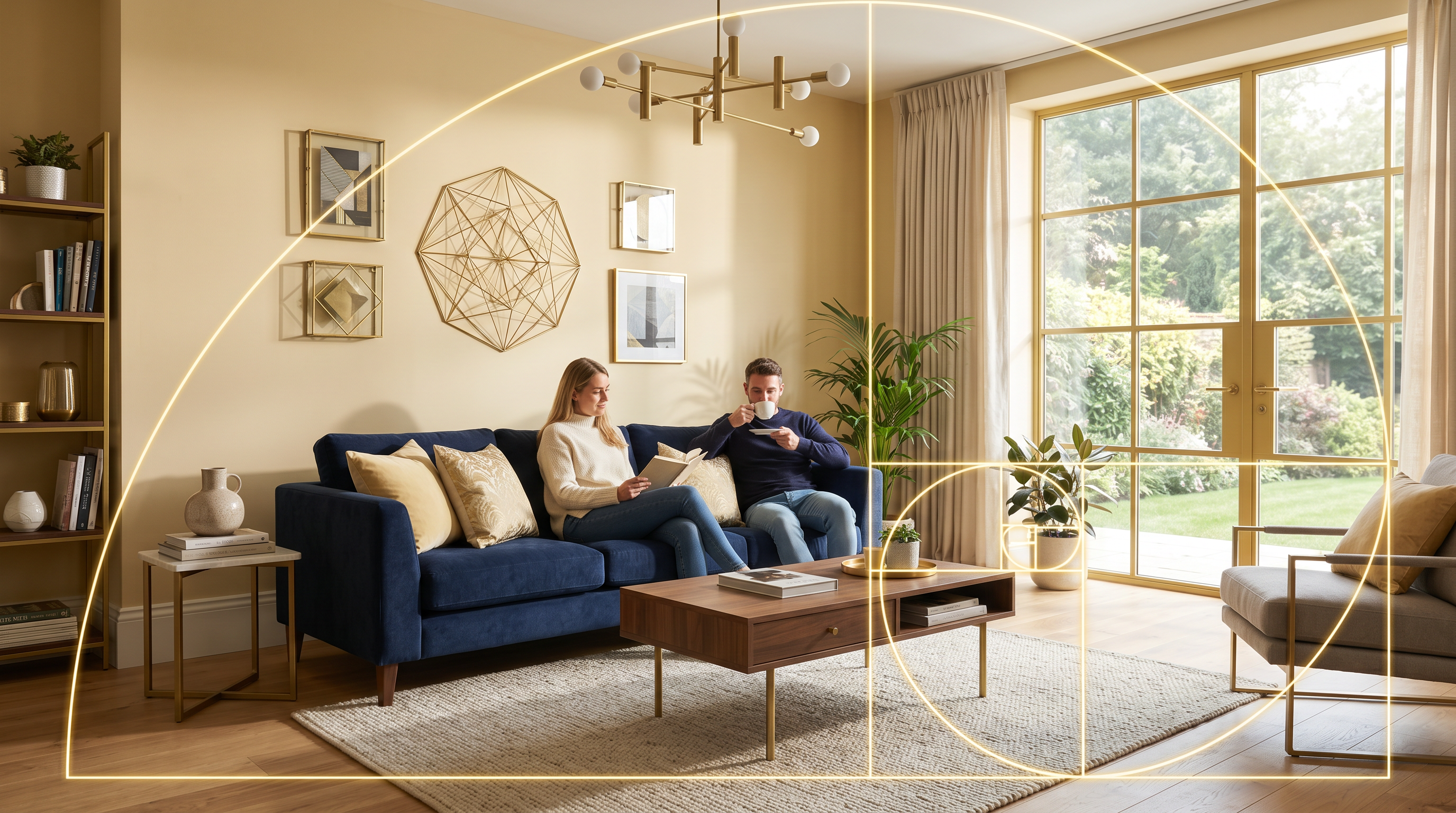
Imagine stepping into a room where every line whispers equilibrium, where your eye dances effortlessly from one element to the next, soothed by an invisible rhythm. This isn't mere chance—it's the golden ratio in interior design at work, a mathematical principle rooted in nature's own blueprint. Known as Phi (φ ≈ 1.618), the divine proportion has captivated artists, architects, and designers for millennia, from the Parthenon's facade to Leonardo da Vinci's Vitruvian Man. In modern homes, it transforms chaotic spaces into sanctuaries of timeless harmony.
Why does it matter? Our brains are wired for balance. Studies in environmental psychology reveal that proportionally harmonious spaces reduce stress, boost creativity, and even enhance social interaction. Jarring asymmetries trigger unease; golden proportions deliver subconscious delight. As a professional interior designer, I've witnessed rooms reborn through this ancient math—spaces that feel larger, more inviting, eternally elegant. This ultimate guide dives deep into applying the golden ratio to interior design proportions, empowering you to craft divine proportion home decor that endures.
Room Dimensions: Crafting the Perfect Shell with Phi
The foundation of golden ratio in interior design begins with the room's shell—its walls, floors, and ceilings. Start by envisioning your space as a living rectangle governed by Phi. Ideally, a room's length should be 1.618 times its width. For a 10-foot-wide living room, aim for approximately 16.18 feet in length. Height plays a starring role too: divide the wall height by Phi to find optimal window or door placements.
Picture a rectangular living area, 12 feet wide by 19.4 feet long (12 × 1.618). Ceilings at 9 feet? Position crown molding or wainscoting at the golden section: 9 / 1.618 ≈ 5.56 feet from the floor. This creates a visual anchor that elevates the entire shell. In renovations, if altering dimensions isn't feasible, use rugs or furniture clusters to simulate these proportions, tricking the eye into perceiving ideal interior design proportions.
Practical Calculations for Architects and Designers
- Width (W): Measure your base dimension.
- Length (L) = W × 1.618
- Golden section point = Total height × 0.618 (from bottom)
- Apply to alcoves, niches, or even fireplace mantels for subtle harmony.
This furniture layout math ensures the room's skeleton breathes balance, setting the stage for every layer to follow.
The 60-30-10 Color Rule and Its Golden Ratio Connection
Enter the 60-30-10 rule golden ratio adaptation—a cornerstone of professional interior design guides. Traditionally, allocate 60% of your palette to a dominant color (walls, major furniture), 30% to secondary (upholstery, rugs), and 10% to accents (art, pillows). But here's the divine twist: the golden ratio splits surfaces into roughly 61.8% and 38.2%. The 60-30-10 is its practical sibling, mirroring Phi's essence for color distribution.
In a sunlit living room, paint 62% of surfaces (walls) in warm neutrals like soft taupe. Layer 30% in complementary mid-tones on sofas and curtains, reserving 8-10% for bold pops—golden mustard vases or emerald lamps. This isn't arbitrary; it's calibrated to evoke nature's palette, from sunflower spirals to nautilus shells. The result? Divine proportion home decor that feels vibrant yet serene, colors flowing like a symphony.
Furniture Placement: Mastering Proportions with 1.618
Now, populate your shell. For sofa sizing, let the room dictate: if your space is 16 feet long, the sofa should span about 16 / 1.618 ≈ 9.9 feet. Coffee tables? One-third the sofa length, or scaled by Phi for nesting perfection. Arrange in golden rectangles: position the main seating at the 0.618 point along the wall.
Key Furniture Layout Math Formulas
- Sofa length = Room length / φ (≈ room length × 0.618)
- Coffee table = Sofa length / φ
- Side tables flank at golden sections of the sofa arms.
- TV or focal art: centered at wall's golden mean height.
Envision a den: oversized sectional cramps the flow; a Phi-scaled loveseat invites conversation. This precision turns furniture from clutter to choreography.
Wall Art & Decor: The Eye-Level Golden Rule
Art demands reverence. Hang at eye level? Refine it: the center of your piece at 0.618 of the wall height from the floor. For a 96-inch wall, that's 59.3 inches up. Size matters too—art width = wall width × 0.618. Cluster galleries in golden spirals, each frame overlapping by Phi ratios.
Mirrors amplify: position to reflect golden sections, bouncing light harmoniously. Shelves above consoles? Divide the wall into Phi segments for flawless symmetry.
Lighting & Fixtures: Illuminating with Precision
Chandeliers hover at table height's golden extension: for a 30-inch table, pendant bottom at 30 × 1.618 + clearance ≈ 60 inches from floor. Sconces flank doors at Phi points. Track lighting arcs along golden curves, sculpting shadows poetically.
In bedrooms, bedside lamps scale to nightstand width by 1.618, casting pools of light that caress the space.
Shelving & Built-Ins: Mathematical Division Mastery
Bookcases thrive on progression: tallest shelf full height, each subsequent one shorter by factor of 1/φ (0.618). A 72-inch unit yields shelves at 72, 44.5, 27.5 inches—endless visual rhythm. Kitchen islands? Counter divided into Phi zones for appliances and prep.
Before and After: Transforming Unbalanced Chaos into Harmony
Before: A 14x10-foot living room crammed with a 12-foot sofa against a short wall, clashing art dwarfing the space, colors screaming in 50-50 splits. The eye bounces frantically, tension palpable—like a storm in a bottle.
After: Sofa resized to 8.6 feet (14/1.618), placed at golden point. 60% soft grays, 30% blues, 10% brass accents. Art gallery spirals up the 9-foot wall, lights poised perfectly. Suddenly, the room expands, breathes—guests linger, conversations bloom. This is golden ratio in interior design magic.
Actionable Guide: Harness GetRatioGolden.com for Your Next Refresh
Democratize the math with GetRatioGolden.com. Input room dimensions; it spits Phi-scaled furniture sizes, color splits, art placements. Step-by-step:
- Enter width/length/height.
- Select room type (living, kitchen).
- Generate layouts, export sketches.
- Overlay on photos for virtual mocks.
Designers, integrate it into client pitches—precision meets persuasion.
Common Mistakes to Avoid in Golden Ratio Application
- Over-calculating: Math serves beauty; if it stifles intuition, pivot.
- Ignoring flow: Phi rectangles can't fix poor traffic paths.
- Poor scaling: Applying to mini-spaces without adjustment yields dollhouse vibes.
- Neglecting context: Historic homes demand softer interpretations.
Conclusion: Phi as Your Timeless Design Ally
The golden ratio in interior design isn't a rigid formula—it's a lens for perceiving harmony in chaos. From room shells to final flourishes, it infuses spaces with nature's poetry, crafting environments that nurture the soul. Architects, digital artists, enthusiasts: wield Phi boldly. Your next project won't just look good—it'll resonate eternally. Step in, measure up, and let the proportions unfold.
