
Golden Ratio in Art: Unveiling the Divine Proportion (Phi) from Da Vinci to Dalí
Introduction: The Artist's Secret Weapon—The Divine Proportion (Phi)
Imagine standing before a canvas where every curve, every line, every gaze pulls you inexorably toward the heart of the composition. This isn't mere intuition; it's mathematics woven into mastery. The golden ratio in art, known as the divine proportion or Phi (approximately 1.618), has been the artist's secret weapon for centuries. Derived from the Fibonacci sequence—where each number is the sum of the two preceding ones (1, 1, 2, 3, 5, 8, 13...)—Phi emerges as the ratio between consecutive Fibonacci numbers approaches perfection.
In paintings and sculptures, this ratio creates phi in art that feels inherently harmonious, guiding the viewer's eye with effortless grace. From Renaissance geniuses to Surrealist provocateurs, artists have harnessed golden ratio composition to evoke emotion and eternity. Why does it captivate? Because it mirrors nature's patterns—in nautilus shells, galaxies, human bodies—turning art into a bridge between the cosmos and canvas. For designers, digital artists, and architecture students, understanding this unlocks compositions that resonate on a primal level.
Leonardo da Vinci: Detailed Analysis of The Last Supper, Vitruvian Man, and the Mona Lisa
The Last Supper: Windows and Apostles in Phi Harmony
Leonardo da Vinci golden ratio obsession shines brightest in The Last Supper (1495-1498). Overlay a golden rectangle on the painting, and the central window arch divides precisely by Phi, framing Christ as the focal point. The apostles cluster in groups of three, their spacing echoing Fibonacci numbers: 3, 5, 3. This da vinci golden ratio creates dynamic tension, drawing eyes from Judas's shadowed isolation to the serene Savior, embodying divine proportion in paintings.
Vitruvian Man: Proportions of the Universe
Da Vinci's iconic sketch (c. 1490) literalizes phi in art. The figure's navel-to-foot distance versus navel-to-crown measures 1.618, aligning with Vitruvius's ancient ideals. Arms outstretched form golden triangles; the circle and square intersect at Phi-scaled points. It's art history math at its purest—a blueprint for human proportion that architects and designers still reference.
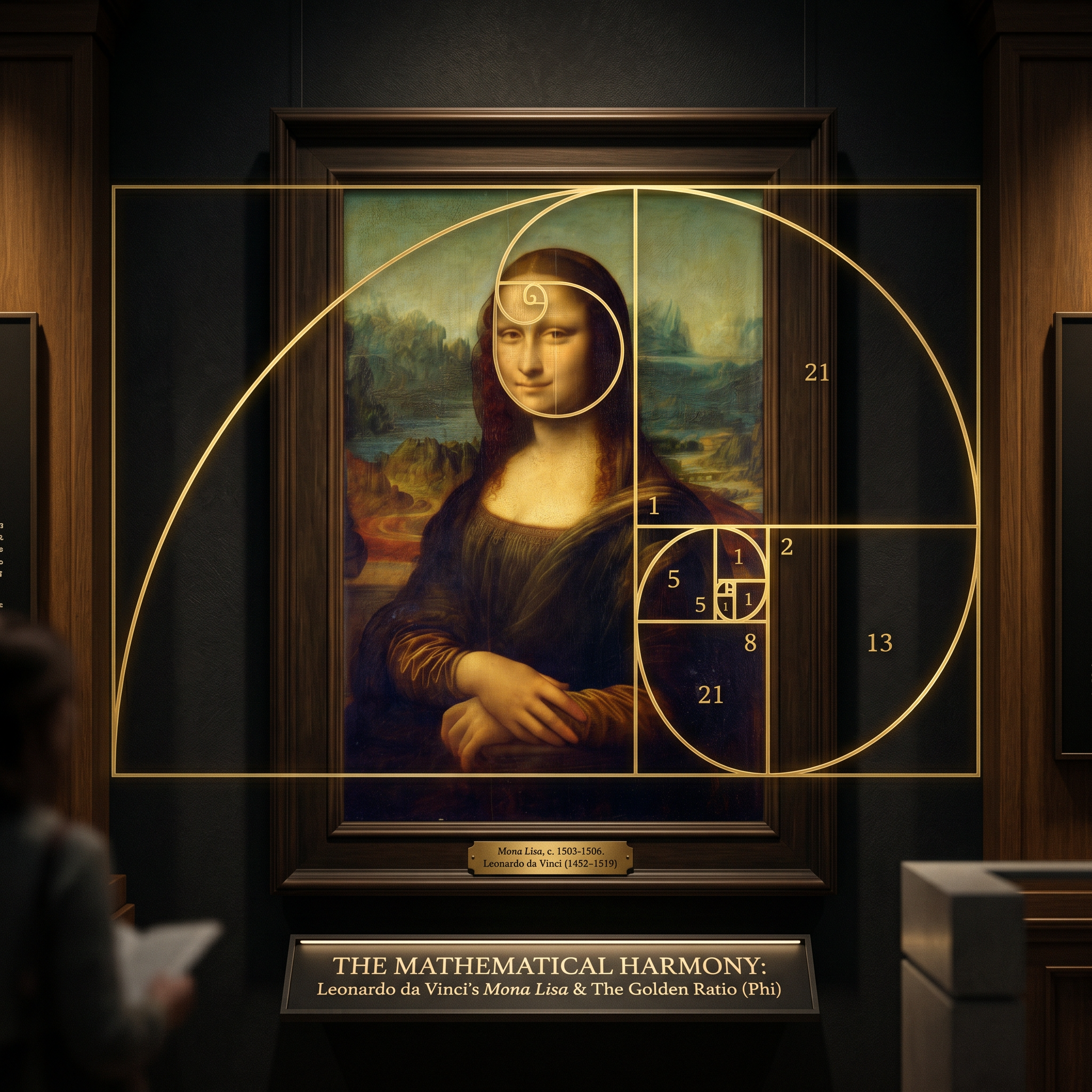
Mona Lisa: Subtle Spirals in Her Smile
Her enigmatic gaze? Golden ratio composition. The face's width-to-length ratio is Phi; eyes, nose, and mouth align along logarithmic spirals. The landscape recedes in Fibonacci-scaled layers, pulling viewers into infinity. Da Vinci didn't just paint; he encoded the universe.
Michelangelo: The Mathematical Grace of the Sistine Chapel
High above St. Peter's faithful, Michelangelo's Sistine Chapel ceiling (1508-1512) pulses with fibonacci in art. In The Creation of Adam, God's silhouette forms a golden rectangle; Adam's arm curves along a Phi spiral toward the divine touch. The sibyls and prophets sit in poses where torso-to-limb ratios hit 1.618. This art history math elevates frescoes from decoration to divine geometry, guiding eyes across 9,000 square feet with effortless flow. Michelangelo, trained in architecture, infused sculpture-like precision, proving golden ratio in art transcends medium.
Salvador Dalí: Explicit and Intentional Use of Phi in 'The Sacrament of the Last Supper'
Fast-forward to 1955: Salvador Dalí's The Sacrament of the Last Supper flaunts phi in art brazenly. A massive dodecahedron—its edges golden—hovers transparently, each face a Phi-scaled pentagon. Apostles encircle Christ in Fibonacci intervals; the elongated table follows golden rectangles. Dalí bragged of this divine proportion in paintings, calling it "cosmic harmony." Unlike subtle Renaissance nods, his golden ratio composition screams intentionality, blending Surrealism with sacred math for a modern congregation.
Sandro Botticelli: The Flowing Geometry of 'The Birth of Venus'
Botticelli's The Birth of Venus (c. 1485) rides waves of golden ratio in art. Venus's shell divides by Phi; her body's S-curve traces a logarithmic spiral. Zephyr and Chloris propel her ashore in Fibonacci-proportioned gusts. The canvas's overall width-to-height is 1.618, creating golden ratio composition that mirrors ocean rhythms. It's flowing geometry personified—elegant, ethereal, eternally balanced.
Renaissance Composition: How Master Artists Applied Mathematical Harmony to Guide the Viewer's Eye
Renaissance masters didn't stumble on phi in art; they studied it. Golden spirals directed narratives—eyes spiraling from foreground figures to divine horizons. In Raphael's School of Athens, philosophers cluster in Phi rectangles, fostering intellectual flow. This art history math ensured compositions felt alive, not static, training viewers' gaze like a composer's crescendo. Architects among them, like Brunelleschi, ported it to domes and facades, birthing harmonious cities.
Modern Art: How Contemporary Artists and Digital Designers Still Rely on the Ratio
Phi endures in pixels. Photographer Gregory Crewdson stages scenes with golden ratio composition; architect Zaha Hadid's fluid forms echo Fibonacci curves. Digital artists in Adobe tools overlay Phi grids for logos—think the subtle spirals in National Geographic's frame. UI designers scale app elements by 1.618 for intuitive navigation. Even album covers, like Pink Floyd's Dark Side of the Moon prism, align to Phi. In our data-driven era, golden ratio in art grounds creativity in timeless truth.
Practical Guide: Step-by-Step on How to Apply Golden Ratio Composition to Your Own Artwork
Ready to wield the divine proportion in paintings? Here's your toolkit.
- Generate the Grid: Start with a square. Multiply side by Phi (1.618) for rectangle length. Repeat, subtracting squares to form a spiral. Tools like Photoshop's Golden Ratio plugin or Figma overlays automate this.
- Place Focal Points: Position subjects at spiral intersections or rectangle junctions—where Phi "power points" lie, like the 0.618 mark.
- Scale Elements: Size figures, horizons, or UI buttons progressively by Fibonacci (1, 2, 3, 5 units). Faces: eyes at 0.618 height from chin.
- Test Eye Flow: Trace paths—does it spiral naturally? Adjust for dynamism.
- Iterate in Nature: Photograph shells or leaves; mimic their Phi for authenticity.
- Digital Twist: In Blender or Illustrator, apply Phi transforms to paths for organic curves.
Practice on sketches; soon, golden ratio composition becomes instinct.
Conclusion: The Enduring Legacy of Mathematical Beauty
From Da Vinci's sfumato depths to Dalí's dodecahedral dreams, the golden ratio in art proves math isn't cold—it's the heartbeat of beauty. Phi whispers universality: what pleases in a Parthenon frieze thrills in today's apps. For designers and artists, it's not a rule but a rhythm, inviting creation that endures. Next time you compose, ask: Does it spiral like the universe? Harness Phi, and your work will answer yes.
