
Golden Ratio in Art: How the Masters Used Phi to Create Timeless Masterpieces
The Hidden Harmony: Why Masterpieces Feel Perfect
Picture yourself in the dim hush of the Louvre, eyes locked on the Mona Lisa. Her smile tugs at something deep within, an inexplicable pull that lingers long after you turn away. Why do certain paintings exert this magnetic psychological weight? Why do they feel inherently right, as if the canvas itself breathes with natural order?
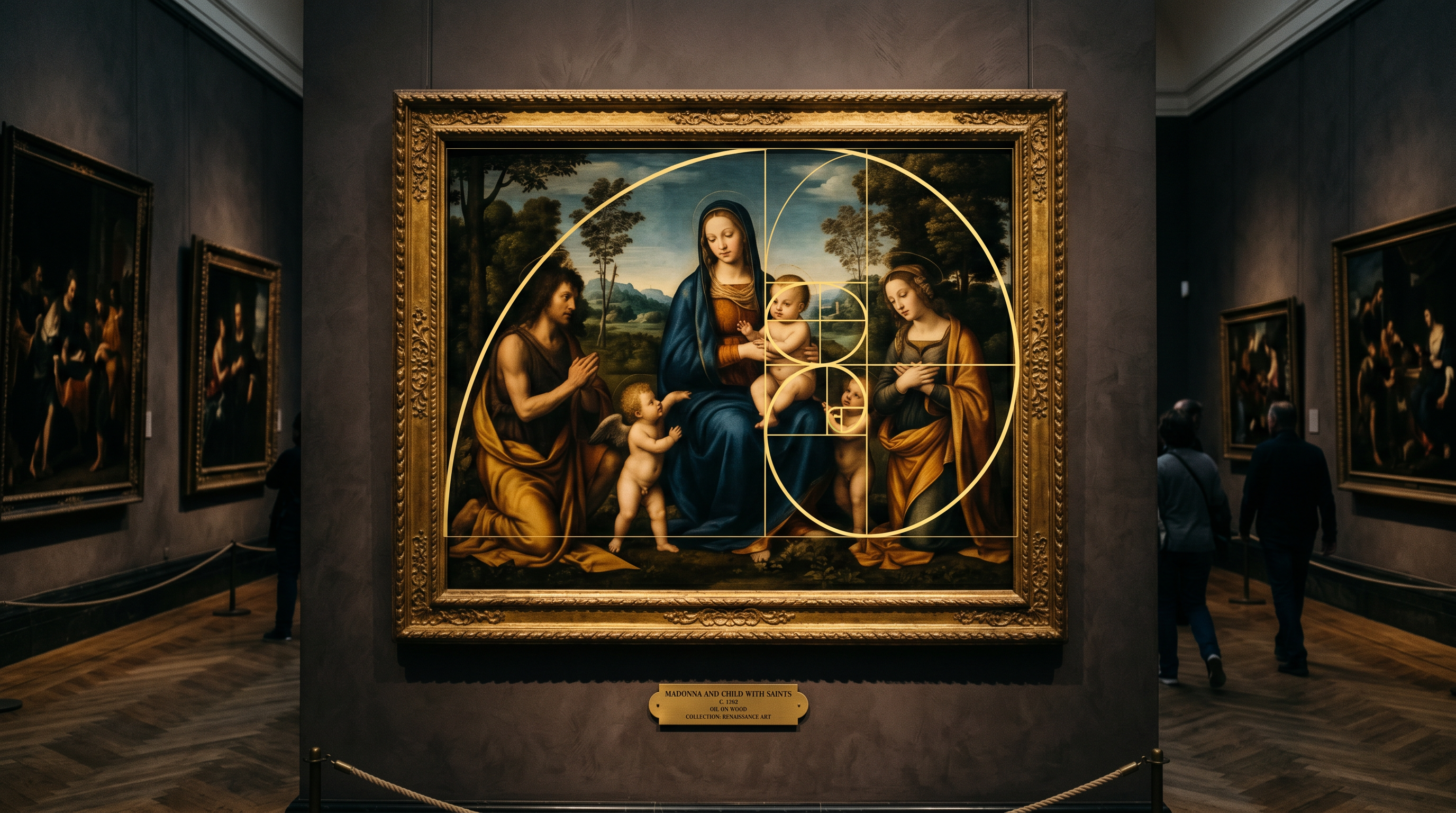
The answer lies in a deceptively simple mathematical constant: phi, or φ, approximately 1.618033. Known as the golden ratio, this irrational number—derived from the Fibonacci sequence where each number is the sum of the two preceding ones—has whispered through nature's spirals, from nautilus shells to galaxy arms. In art, it's the divine proportion, the invisible scaffold masters used to craft golden ratio paintings that resonate across centuries.
Phi isn't just math; it's the architecture of beauty, turning chaos into timeless harmony.
This golden ratio in art creates balance, guiding the eye in a rhythmic dance that mimics life's organic flow. Professional designers, architects, and digital artists today tap into this same phi in painting to evoke that elusive sense of perfection.
Leonardo da Vinci & The Divine Proportion
No figure embodies the fusion of art and mathematics like Leonardo da Vinci. His works bristle with phi in art history, where proportions align to phi with uncanny precision. Take the Vitruvian Man (c. 1490), that iconic sketch of a man inscribed in a circle and square. The figure's navel marks the golden section dividing the height from head to foot, embodying Renaissance ideals of human proportion rooted in antiquity but refined through phi.
In The Last Supper (1495-1498), da Vinci's structural genius shines. The central window behind Christ divides the composition along golden rectangles. Apostles cluster in phi-based groupings, their gestures spiraling outward in a golden spiral that draws the gaze inexorably to the Savior. Is this intentional? Scholars debate: some see deliberate geometry, others interpretive overlays. Yet the harmony is undeniable, fueling the fresco's enduring power.
The Mona Lisa Enigma
Da Vinci's masterpiece, the Mona Lisa (1503-1506), layers phi like a Renaissance onion. Her face occupies a golden rectangle within the frame; the eyes, nose, and mouth align to phi points. Even the winding landscape recedes in golden spirals, blending portrait and vista into divine unity. Collaborating with mathematician Luca Pacioli, da Vinci didn't stumble into this—he wielded phi as a tool for emotional depth.
- Vitruvian Man: Navel-to-height ratio ≈ φ
- Last Supper: Window and table divide canvas by golden sections
- Mona Lisa: Facial features and horizons trace phi spirals
De Divina Proportione: Codifying Phi in Art
Da Vinci's partnership with Pacioli crystallized in De Divina Proportione (1509), a treatise that elevated the golden ratio to divine status. Pacioli, a Franciscan friar and math luminary, penned the text, while da Vinci supplied 60 exquisite woodcut illustrations of polyhedra—Platonic solids inscribed in golden proportions.
The book dissects phi's properties: how a line divided such that the whole to the larger part equals the larger to the smaller yields φ. It argues this divine proportion art mirrors God's design, applicable to architecture, sculpture, and painting. Pacioli dedicates it to Ludovico Sforza, positioning phi as the key to beauty's vault. For artists, it was a blueprint, transforming abstract math into practical composition.
Woodcuts like the dodecahedron and icosahedron showcase edges and faces in golden ratios, proving geometry's aesthetic supremacy. This text didn't just document—it inspired generations of golden ratio paintings.
Michelangelo & The Sistine Chapel: Divine Touchpoints
Ceiling-bound on scaffolding for four years, Michelangelo Buonarroti infused the Sistine Chapel with muscular divinity. Nowhere is phi in painting more electric than in The Creation of Adam (1512), the fresco's centerpiece.
God's surging form and Adam's languid reach culminate in fingers nearly touching—a spark of life. Measure from the panel's edges: the apex of connection hits precisely at golden ratio points both horizontally and vertically. Adam's elbow, God's knee—each aligns to phi grids, creating dynamic tension amid celestial swirl.
In that almost-touch, Michelangelo etched eternity with mathematics.
This wasn't accident; Michelangelo studied classical proportions, internalized phi through Renaissance humanism, making the divine proportion pulse through Vatican vaults.
Salvador Dalí: The Surreal Mathematician
Fast-forward to 1955: Salvador Dalí, the mustache-twirling surrealist, declared himself "Mathematique." His The Sacrament of the Last Supper brazenly flaunts golden ratio in art. A dodecahedron—its 12 pentagonal faces golden by nature—hovers above elongated apostles gathered at a transparent polygonal table.
The frame's dimensions form golden rectangles; Christ stands at the phi intersection, rays emanating in spiral harmony. Dalí sketched logarithmic spirals from the central figure, echoing nautilus precision amid melting clocks' legacy. Here, divine proportion art meets dream logic, proving phi's versatility across eras.
Pointillism & Impressionism: Order in the Dots
Georges Seurat's Calculated Chaos
Georges Seurat's A Sunday Afternoon on the Island of La Grande Jatte (1884-1886) transforms Impressionist blur into pointillist precision. Over 3 million dots build a park scene, but phi governs the whole. The central female figure with parasol sits at the golden section; figures arc in spirals, boats and trees subdivide by φ.
Seurat plotted compositions on phi grids before dotting, imposing mathematical order on fleeting light. This phi in art history elevates the painting from snapshot to symphony.
Modernism & Geometry: Piet Mondrian's Rectangles
Piet Mondrian's neoplasticism stripped art to primaries and grids, yet his canvases whisper phi. In Composition with Red, Blue, and Yellow (1930), black lines form golden rectangles; color blocks nest in φ proportions. Mondrian denied mysticism, claiming pure abstraction, but measurements reveal uncanny alignments—short sides to long ≈ 1:φ.
Works like Broadway Boogie-Woogie pulse with rhythmic divisions echoing golden spirals. Modernists harnessed golden ratio paintings for universal harmony amid industrial flux.
The Modern Creator's Toolkit: Harnessing Phi Digitally
Today's professional designers, architects, digital artists, and typography enthusiasts needn't guess. Tools like the GetRatioGolden calculator overlay phi grids on sketches, ensuring compositions hit that natural harmony. In Adobe Photoshop or Illustrator, enable golden spiral guides; Figma plugins compute rectangles on the fly.
- Divide canvases into golden sections for focal points
- Scale type hierarchies by φ for rhythmic flow
- Architect facades with phi proportions for organic grandeur
- Test logos: does the emblem spiral invitingly?
Phi demystifies mastery, empowering you to craft divine proportion art that captivates instinctively.
Phi: Bridging Math and the Muse
From da Vinci's enigmas to Dalí's dodecahedrons, the golden ratio threads through art history like a cosmic constant. It's the silent partner in golden ratio in art, lending logic to emotion, structure to soul. As you wield phi in your next project, remember: you're joining masters who saw the universe's code—and painted it eternal.
In a world of pixels and polygons, this divine proportion remains the ultimate harmony hack. What timeless masterpiece will you create?
