
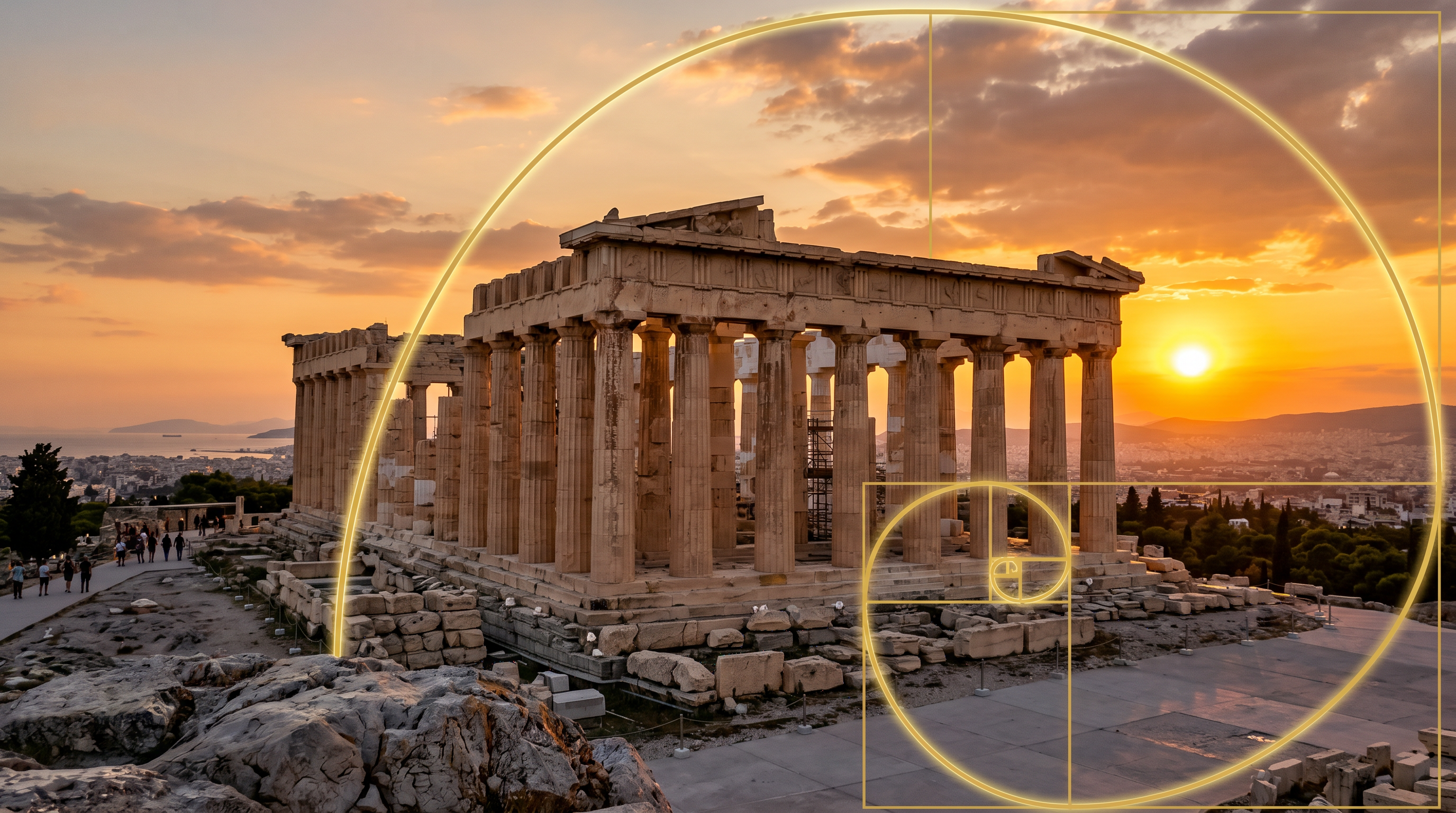
Golden Ratio in Architecture: Divine Proportion from Parthenon to Modern Marvels
Imagine standing before the Parthenon at dusk, its columns casting long shadows that seem to whisper secrets of perfection. What invisible force binds this ancient temple to the sleek curves of a modern skyscraper, evoking an almost visceral sense of architectural mathematical harmony? The answer lies in the golden ratio, that enigmatic proportion known as φ (phi) ≈ 1.618, the Divine Proportion revered by architects across millennia. This irrational number, where the ratio of the larger segment to the smaller equals the whole to the larger, has shaped humanity's greatest edifices, from sun-baked ruins to glass-clad towers. For professional designers, architects, digital artists, and typography enthusiasts, understanding golden ratio in architecture unlocks a timeless toolkit for aesthetic mastery.
Far from mere numerology, phi emerges organically in nature—spirals of nautilus shells, sunflower seeds, even human anatomy. Architects have long intuited its power to create balance, rhythm, and an elusive beauty that feels innate. As we journey from classical antiquity to parametric wonders, we'll explore how phi in architecture endures, fueling both reverence and innovation.
The Greek Standard: Parthenon and the Birth of Phi in Architecture
Atop the Acropolis, the Parthenon stands as the ur-text of Parthenon golden ratio. Constructed between 447 and 432 BCE by architects Ictinus and Callicrates under Phidias—the very name echoing phi—this Doric temple to Athena wasn't built by accident. Its facade dimensions approximate φ with uncanny precision: the width to height ratio hovers near 1.618, while column spacing follows subtle entasis curves that nod to the golden section.
Measure the front facade: 101.3 feet wide by 62.4 feet tall yields a ratio of roughly 1.618. The stylobate (platform) and pediment heights cascade in phi-derived sequences. Even the sculptural friezes divide into panels where metope widths relate to triglyphs by the golden mean. These weren't crude approximations; ancient Greek architects wielded tools like compasses and knotted ropes to embed sacred geometry architecture, believing it mirrored cosmic order. The result? A structure that appears to breathe, its proportions drawing the eye effortlessly upward, evoking divine equilibrium amid the chaos of battle-scarred Athens.
Why It Works: Optical Refinements and Phi
The Parthenon's magic lies in entasis—a gentle swell in columns preventing optical illusion of concavity—and corner columns slightly thicker and closer, all calibrated to phi. This golden ratio in architecture creates dynamic tension, making static stone feel alive. Modern overlays confirm it: digital reconstructions using CAD software reveal phi spirals unfurling from the naos (inner sanctum) outward.
Medieval Mastery: Sacred Geometry in Gothic Cathedrals
Fast-forward to the Middle Ages, where masons transformed phi into soaring spires. Notre-Dame de Paris (1163–1345) exemplifies divine proportion in buildings. Its rose window diameter to nave height ratio approximates 1:φ, while the transept arms divide the cross-plan in golden sections. Gothic architects, steeped in Pythagorean mysticism, used phi in architecture via geometric constructions—vesica piscis arches yielding rose windows that fractalize phi outward.
Chartres Cathedral pulses with it: the labyrinth's path encodes phi turns, and the west facade's portals scale by golden rectangles. These weren't whims; medieval guilds guarded secretis architectonicis, blueprints tracing phi from ad quadratum (square) to ad triangulum (triangle) grids. Vault ribs and flying buttresses cascade in phi progressions, lifting stone heavenward in a hymn to mathematical harmony. Picture a pilgrim's awe: light filtering through stained glass, proportions aligning body and soul toward transcendence.
The Great Pyramid Debate: Phi in Ancient Egypt?
Does the Great Pyramid of Giza (c. 2580 BCE) harbor golden ratio in architecture? Proponents point to the apothem (face slant height) to half-base ratio nearing φ, and cross-sectional geometry where height h satisfies h / (base/2) ≈ φ amid π integrations. The King's Chamber proportions—diagonal to side ≈ 1.618—fuel speculation.
Skeptics counter: ancient Egyptians favored seked (slope) systems, not explicit phi. Yet overlays reveal golden triangles in passageways, and the pyramid's alignment with Orion's Belt suggests cosmic intent. Whether deliberate or emergent, this debate underscores phi's allure in sacred geometry architecture, blurring engineering and esoterica. For architects today, it's a reminder: proportions persist beyond intent.
The Modulor: Le Corbusier's Human-Scale Revolution
Enter the 20th century: Le Corbusier, modernism's maestro, codified phi in his 1948 Modulor system. Scaling the human figure—6 feet tall with arm raised—he derived a sequence blending metric, imperial, and φ ≈ 1.618. Red and blue bands marked growth: 1.08m (brick height), scaling by phi to 2.70m (door height), up to monumental spans.
Applied in Unité d'Habitation (Marseille, 1947–1952), pilotis and brise-soleil facades unfold in golden spirals. Le Corbusier declared it "the key to human scale," countering industrial anonymity with architectural mathematical harmony. Typography enthusiasts note its influence on grids, where baselines echo Modulor ratios for visual flow.
Modern Marvels: UN Building and CN Tower
Postwar icons embrace phi. The UN Secretariat (New York, 1947–1952) by Le Corbusier et al. features a slab where height to width ≈ φ, slender form slicing the skyline. Its curtain wall divisions follow golden sections, marrying function to form.
The CN Tower (Toronto, 1976) spirals upward: antenna to pod ratios approximate φ, base to apex cascading in golden rectangles. Engineer Yuri Rubinsky embedded phi in architecture for stability and grace, a 553m beacon of divine proportion in buildings.
Contemporary Practice: Algorithmic Design and Phi
Today's parametricists wield software like Grasshopper and Rhino, generating golden ratio in architecture via scripts. Zaha Hadid's fluid forms, Frank Gehry's billows—all trace phi lattices for organic flow. Beijing's Bird's Nest Stadium (2008) weaves steel in phi-modulated weaves, balancing spectacle and structure.
Digital artists layer phi grids in renders; typographers align serifs to golden means for hierarchy. AI tools now optimize facades, ensuring mathematical harmony at scale.
Practical Application: Harnessing Phi in Home Design
For your studio or renovation, start simple. Frame rooms in golden rectangles: living area width = length × 0.618. Stair risers to treads ≈ φ. Kitchen islands scale counters by phi for ergonomic flow.
- Facade: Window heights to sills in golden section.
- Interiors: Furniture clusters via phi spirals.
- Typography: Logo baselines φ-spaced.
- Landscaping: Pathways curving in golden arcs.
For precision, GetRatioGolden.com delivers pro-grade calculators, overlays, and exports—essential for architects sketching divine proportions.
The Enduring Legacy of the Divine Proportion
From Parthenon's marble poise to algorithmic spires, golden ratio in architecture endures as humanity's bridge to beauty. φ ≈ 1.618 isn't dogma but intuition codified—inviting designers to craft spaces that resonate soul-deep. In a fractured world, this Divine Proportion reminds us: true harmony scales eternally.
