
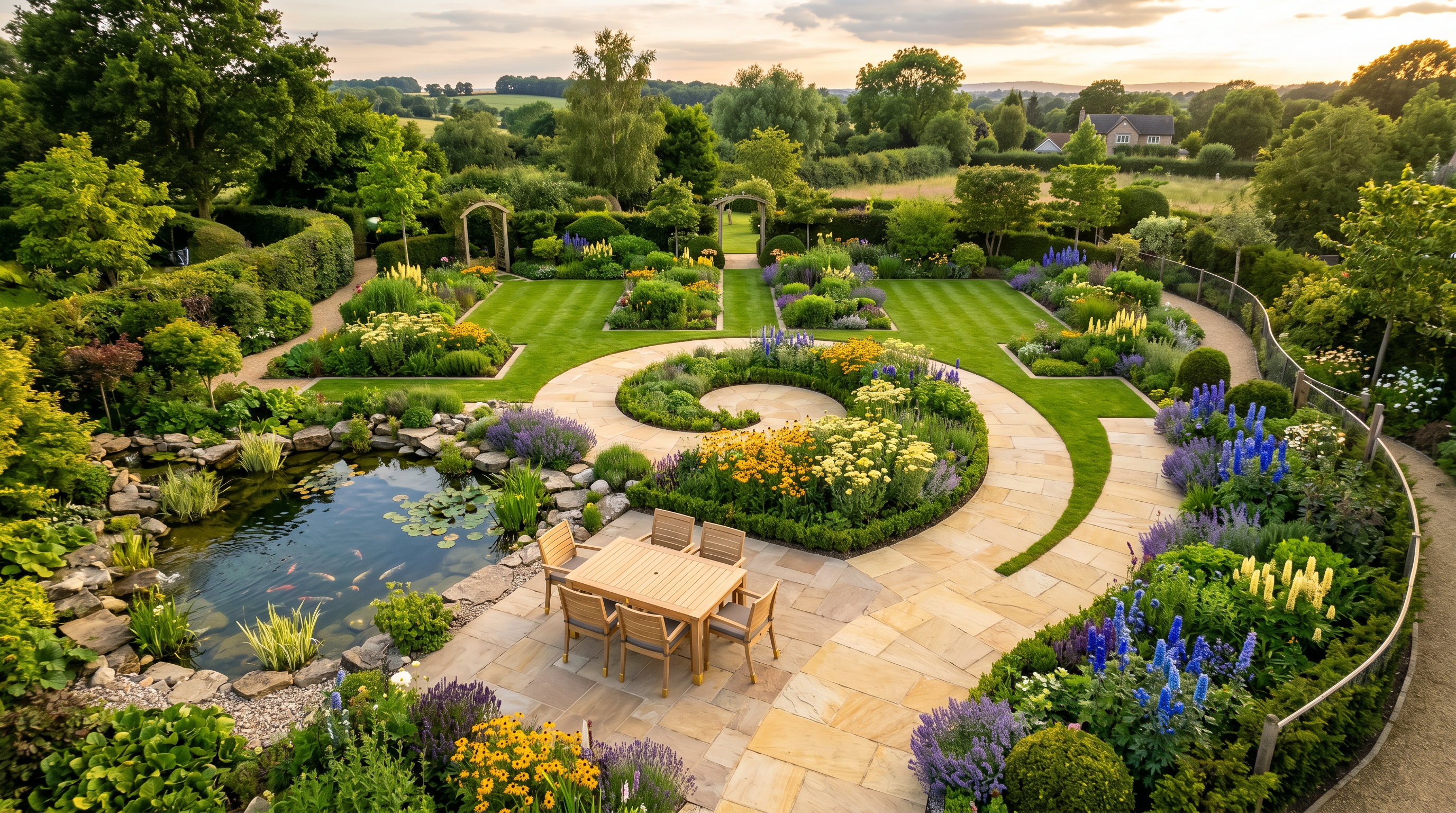
Golden Ratio Gardening: Unlock Phi Garden Design Secrets for Divine Landscape Harmony
The Secret Code Behind Nature's Most Captivating Gardens
Imagine wandering through a garden where every curve beckons your eye, every planting cluster feels effortlessly alive, and the overall harmony leaves you breathless. Now picture the opposite: a jumbled yard of mismatched beds, crooked paths, and overcrowded corners that scream chaos rather than serenity. What separates these worlds? It's not luck or green thumbs alone—it's the golden ratio, φ ≈ 1.618033, nature's divine proportion woven into the fabric of beauty itself.
In golden ratio gardening, this ancient mathematical principle—often called the Divine Proportion—transforms ordinary landscapes into masterpieces of phi garden design. From the spirals of sunflowers to the Parthenon's facade, φ has long guided aesthetic perfection. Professional designers, architects, and passionate home gardeners are rediscovering its power in landscape architecture, creating spaces that feel intuitively right. This deep dive reveals how to apply golden proportion landscape techniques, blending math with horticulture for gardens that pulse with natural elegance.
Crafting the Golden Rectangle: Ideal Garden Bed Shapes
Start with the foundation of any golden ratio garden layout: the golden rectangle. This shape maintains a length-to-width ratio of φ (1.618:1), producing beds that are visually magnetic without trying too hard. Why does it work? Your eye naturally follows the longer side, creating dynamic flow while the shorter dimension grounds the design.
For a practical example, envision a bed measuring 16.18 feet long by 10 feet wide. Plant taller specimens along the length, graduating to low growers at the front. This garden design principles setup mimics nautilus shells and galaxy arms, drawing viewers deeper into the space. Professionals swear by it for client yards—it's scalable from petite urban plots to sprawling estates.
Spiral Paths That Guide the Eye: Walking the Golden Curve
Designing Stone Walkways with Phi Precision
Forget rigid straight lines. In golden ratio gardening, paths curve in a golden spiral, expanding outward in quarter-turn arcs where each segment is φ times larger than the previous. Lay flagstones or gravel to trace this path from entry gate to seating area, and watch how it pulls guests along like an invisible thread.
Architects use software to plot these, but start simple: mark a central point, draw a quarter-circle with radius A, then another with radius A × φ. The result? A walkway that's both functional and mesmerizing, enhancing the Fibonacci garden vibe without overwhelming the plants.
Fibonacci Planting: Nature's Clustering Magic
Symmetry can feel stiff; nature prefers asymmetry rooted in Fibonacci numbers—1, 1, 2, 3, 5, 8, 13, and so on, approximating φ at larger scales. Group perennials in 3s, shrubs in 5s, or bulbs in 13s for clusters that echo pinecones and romanesco broccoli.
- Three salvia plants for a punchy accent.
- Five hostas undulating along an edge.
- Thirteen lavender stems forming a soft wave.
This Fibonacci garden technique avoids the 'row of soldiers' trap, promoting organic drift that pros in landscape architecture use to evoke wilderness tamed.
Golden Sections for Irresistible Focal Points
Divide your garden view into golden sections: 62% (the larger phi portion) and 38%. Place a sun-drenched bench, sculpted urn, or majestic oak at the 62% mark from either side. This 'sweet spot' aligns with how eyes scan compositions, making features pop naturally.
In a 50-foot-wide yard, position that specimen tree at 31 feet from the left—pure phi garden design wizardry that elevates amateur plots to gallery-worthy status.
Phi-Proportioned Patios and Terraces
Hardscaping demands precision too. Size patios at 1.618:1—say, 20x12.4 feet—for terraces that feel expansive yet intimate. Pavers laid in golden rectangles reinforce the theme, blending seamlessly with soft plantings.
Home enthusiasts report these spaces host better dinners; architects note they withstand time's test, much like Renaissance courtyards.
Raised Beds That Scale Like Pros
Dimensions for Visual and Functional Perfection
Build raised beds 10 feet long by 6.18 feet wide, 1.618 feet high. This golden ratio garden layout ensures soil depth supports roots while the surface invites easy reach—no stretching, no waste.
- Calculate your space: Total ÷ φ = width; Total - width = length.
- Use cedar or stone for durability.
- Fill with phi-layered soil: compost over clay.
The Golden Angle: 137.5° for Optimal Plant Spacing
Leaves spiral at 137.5°—the golden angle—for maximum sunlight. Replicate this in spacing: from a central plant, offset the next by 137.5°, scaling distance by φ. Roses spaced thus bloom denser; veggies get superior airflow, slashing disease risk.
It's a cornerstone of advanced garden design principles, turning plots into high-yield paradises.
Water Features at the Spiral's Eye
Ponds and fountains thrive at the golden spiral's tightest curve, the 'eye.' Shape basins as golden rectangles or circles quartered by phi lines. Water's ripple amplifies the harmony, creating tranquil hubs that anchor the entire golden proportion landscape.
Echoes of Japanese Gardens: Intuitive Phi Mastery
Zen rock gardens and koi ponds often unconsciously follow φ—raked gravel spirals, boulders in Fibonacci groups. Study these for golden ratio gardening inspiration: place lanterns at 38% divisions, path stones in 5-8-13 patterns. The result? Timeless poise.
Permaculture Zones with Golden Efficiency
Map zones (daily herbs near door, orchards afar) using phi divisions. Zone 1 at 62% of yard, Zone 2 at φ-scaled distance. Flow feels instinctive, minimizing steps while maximizing bounty—a smart twist on landscape architecture.
Your Essential Tool: Calculate Phi Instantly
Ditch guesswork with the GetRatioGolden calculator. Input total length for instant A, B, and Total values tailored to your plot. It's the pro shortcut for flawless phi garden design.
From Chaos to Harmony: A Transformative Before-and-After
Picture a neglected suburban yard: lopsided beds (10x10 squares), meandering paths, focal bench lost in shrubbery. Post-phi overhaul? Golden rectangle beds (16x10 feet) bloom in Fibonacci clusters. Spiral path leads to a 62%-placed fountain. Raised veggie beds sized perfectly. The shift? From eyesore to envy-of-the-neighborhood, proving golden ratio gardening's alchemy.
What was cluttered now breathes; what was dull now enchants.
Embrace Mathematical Harmony in Your Landscape
Golden ratio gardening isn't mere trend—it's the universe's blueprint for beauty, from DNA helices to distant quasars. By infusing φ into your golden ratio garden layout, you achieve professional precision that delights the senses and stands eternal. Grab your calculator, measure your space, and unlock divine landscape harmony. Your garden awaits its spiral awakening.
