
Golden Ratio Fashion: Master Phi (φ ≈ 1.618) for Divine Proportion Clothing & Flawless Outfits
Have you ever slipped into an outfit that turned heads without effort, draping just right across your frame, elongating your silhouette, and radiating an effortless allure? Or conversely, stared at a mirror reflecting a look that felt... off, no matter how expensive the pieces? This isn't mere chance or subjective taste. It's golden ratio fashion at work—or its absence. The Divine Proportion, embodied by φ ≈ 1.618033, has whispered through the ages in the Parthenon's columns, Da Vinci's masterpieces, and now, in the wardrobes of the world's most precise stylists.
In the realm of phi fashion design, mathematical harmony isn't abstract theory; it's the blueprint for naturally pleasing ensembles. Professional designers and stylists harness this ancient ratio to craft golden proportion clothing that flatters every body type. Imagine your golden ratio outfit not as guesswork, but as engineered elegance—where fashion math meets intuitive beauty. This guide unlocks wardrobe proportions and divine proportion styling, transforming your style from good to transcendent.
The Science of Phi: Nature's Code in Body Proportions
Phi, or φ ≈ 1.618033, emerges from the Fibonacci sequence, where each number approximates the next by this golden multiplier: 1, 1, 2, 3, 5, 8, 13... Nature adores it—from nautilus shells spiraling outward to the branching of leaves. Human bodies echo this too. The average torso-to-leg ratio hovers near 1:1.618, with legs comprising roughly 62% of height (the longer segment) and torso 38% (the shorter). Disrupt this, and silhouettes jar; honor it, and outfits sing.
In golden ratio fashion, we don't fight anatomy—we amplify it. Classical sculptures like Michelangelo's David embody divine proportion styling, their proportions evoking timeless poise. Modern stylists apply the same to wardrobe proportions, ensuring clothing cascades in φ-aligned waves for that naturally pleasing effect.
The 1/3 to 2/3 Rule: Vertical Division for Elongated Silhouettes
Mastering the Phi Split in Everyday Styling
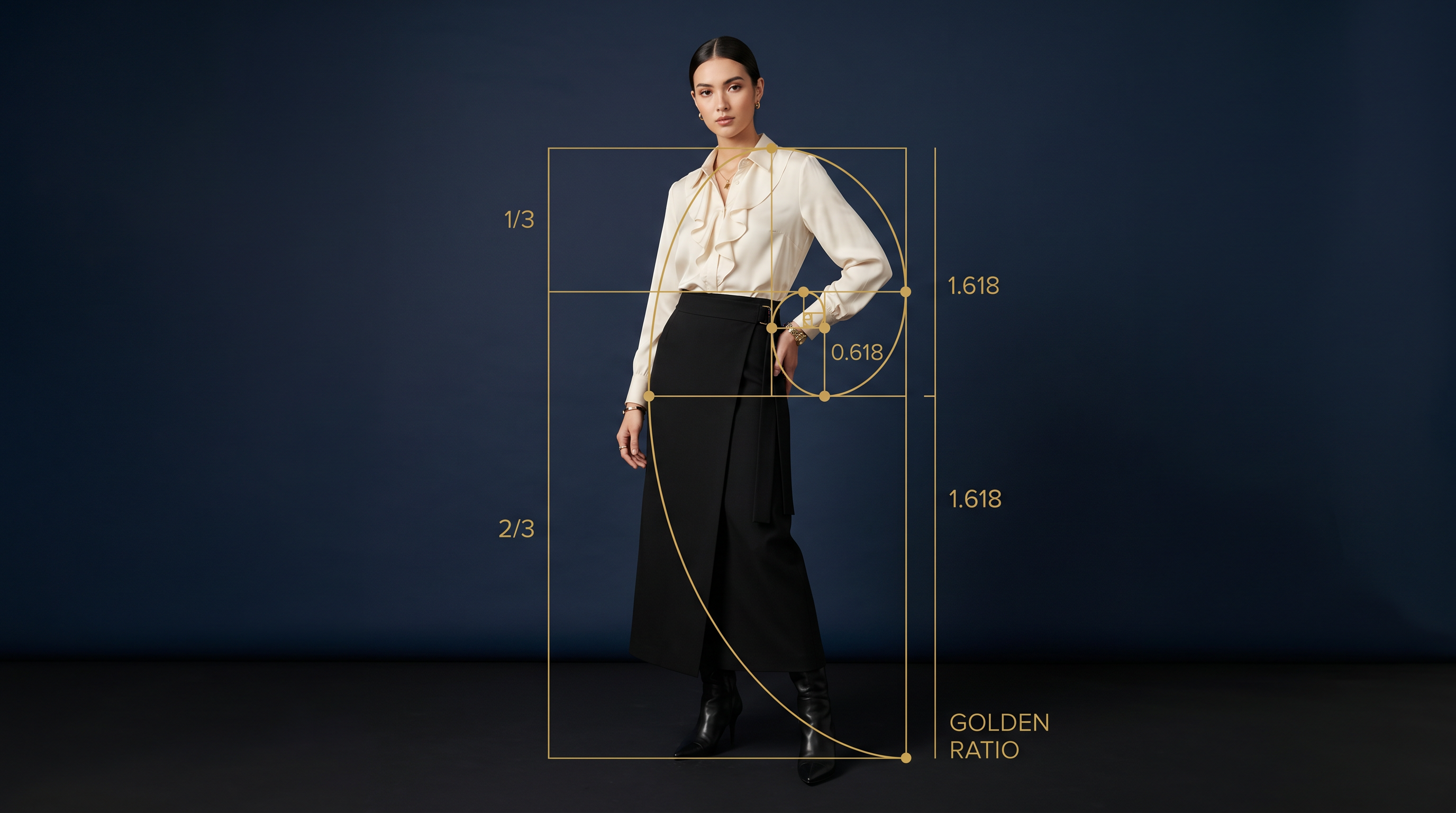
Divide the body vertically at φ ≈ 1.618033 for maximum impact. The upper third (head to hips) should measure about 38% of total height; the lower two-thirds (hips to feet) the rest. This creates the illusion of endless legs, a cornerstone of phi fashion design.
Layer accordingly: A cropped jacket ending at the narrowest point (true waist, φ from shoulders) over high-waisted trousers rising to φ from the floor up. Avoid hemlines that bisect the knee or calf midway—these fracture the flow. Picture a tailored blazer (short segment) atop wide-leg pants (long segment): instant golden proportion clothing.
- Short tops + high waists = leg extension.
- Long coats + cropped pants = balanced drama.
- Seam lines at φ points guide the eye seamlessly.
Accessorizing with Precision: Phi-Scaled Necklaces, Scarves, and Bags
Accessories aren't afterthoughts in divine proportion styling; they're calibrated anchors. For a 5'6" wearer (66 inches), a necklace pendant falls at φ × bustline height—roughly 18-20 inches from the collarbone, grazing the sternum's golden point. Too short? It truncates the neck. Too long? It overwhelms.
Scarves volume follows suit: Drape width at 1/φ of neck circumference for airy poise. Handbags? Strap drop to φ from shoulder height, bag depth 1/φ of your torso—think a petite crossbody (short) on a tall frame (long) for golden ratio outfit equilibrium.
Personalize with the GetRatioGolden Calculator
Unlock your power proportions: Visit the GetRatioGolden calculator. Input height, measure torso-leg split, and receive custom ratios for necklace lengths (e.g., 22 inches for 5'10"), bag scales, and more. Stylists swear by it for client fittings—precision at your fingertips.
Belt Placement: Natural Waist vs. Aesthetic Mastery
The natural waist (narrowest rib-to-hip) differs from the aesthetic one at φ from the shoulders down. Cinch belts here for fashion math magic: It defines without distorting, creating an hourglass echo of divine proportion. Empire waists rise higher (φ from floor), ideal for petites; drop-waists lower for tall frames.
In golden ratio fashion, the belt isn't a constriction—it's a fulcrum of harmony.
Patterns & Prints: Fibonacci in Textile Design
Scaling Motifs for Dynamic Wardrobe Proportions
Fibonacci spirals dictate print scales: Large motifs (φ-sized) dominate bodices, medium cascade to hips, tiny fade into hems. Mixing? Pair bold floral (long segment) with micro-polka (short) for naturally pleasing depth. High-end textiles from Italian mills often embed these sequences, ensuring fabrics flow like living geometry.
- Analyze print density via φ grid overlay.
- Mix scales: Never equal sizes—always progressive.
- Rotate patterns 1/φ for asymmetry that delights the eye.
Color Blocking: Dominant Accents in 1.618 Ratios
Allocate color areas by φ ≈ 1.618033: 62% primary hue (legs or torso), 38% accent (sleeves, collars). A navy sheath with saffron hem block hits the sweet spot—bold yet balanced. Neutrals amplify: Cream (long) over emerald (short) for architectural poise in golden proportion clothing.
Designer Case Studies: Architectural Principles in Couture
Fashion houses like Dior and Balenciaga channel φ instinctively. Dior's New Look skirt volumes explode in golden ratios from cinched waists, elongating postwar silhouettes. Balenciaga's cocoon shapes stack layers in progressive φ scales, their oversized proportions mathematically harmonious despite visual drama. These aren't accidents— they're phi fashion design etched into house DNA, proving golden ratio fashion elevates ready-to-wear to art.
Shoe Math: Heels and Toes in Proportion
Heel height tweaks the leg ratio: Add 2-3 inches (1/φ of calf length) for petites to hit ideal 1:1.618. Pointed toes extend visually (φ from ankle), while blocks ground dramatically. Avoid extremes—over 4 inches shortens the torso segment, fracturing the whole.
Embrace Mathematical Harmony for Timeless Style
Golden ratio fashion isn't rigid math—it's liberation. By mastering φ ≈ 1.618033 in wardrobe proportions and divine proportion styling, your outfits transcend trends, achieving naturally pleasing permanence. Stylists, measure your clients' phi points; designers, weave it into collections. The mirror won't lie: You'll see precision, poise, power. Step into your golden ratio outfit—the universe's favorite proportion awaits.
