
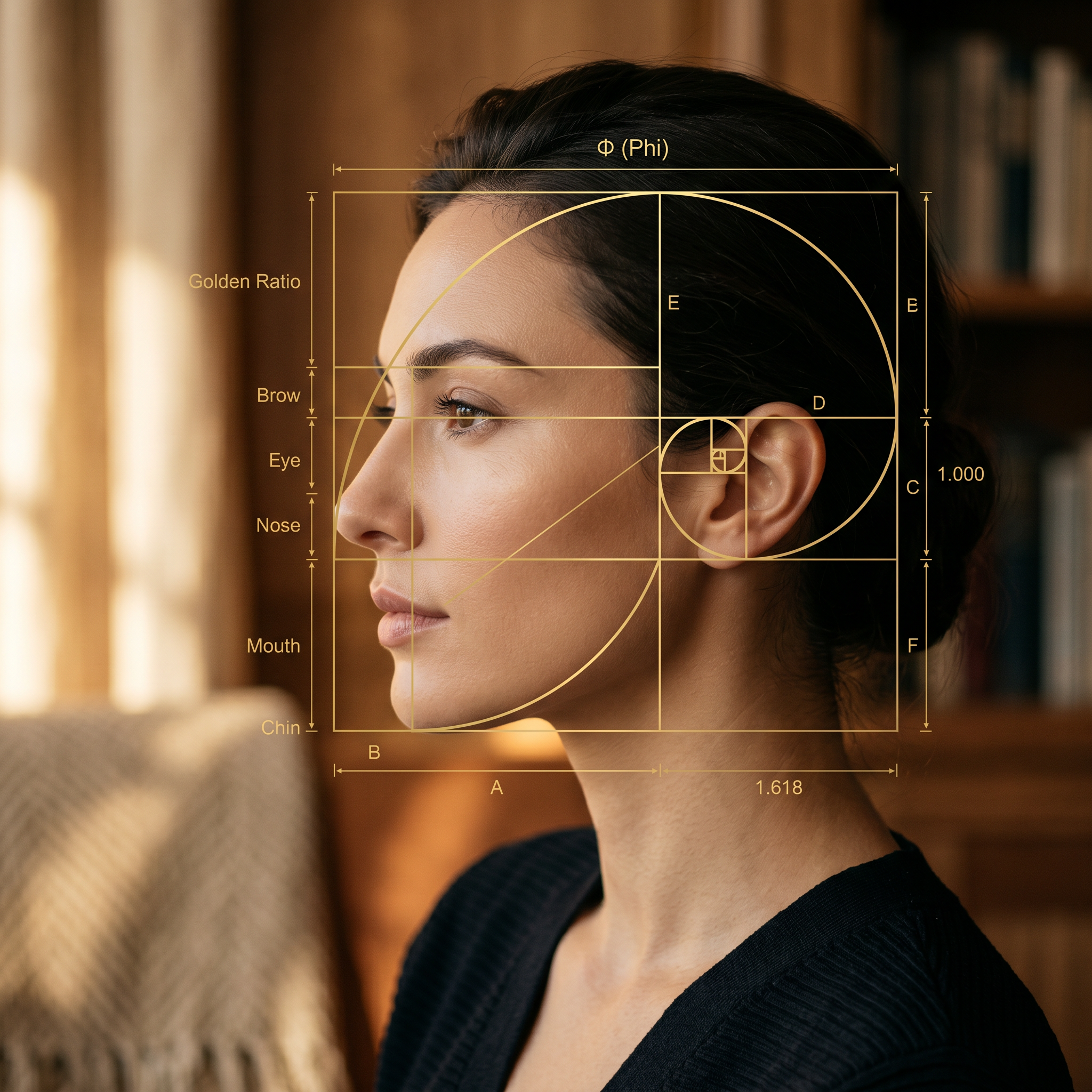
Golden Ratio Face Test: Decode Your Beauty with the Phi Mask and Perfect Proportions
The Timeless Allure: Psychology of Beauty and the Golden Ratio Face
Picture this: a stranger's face catches your eye across a crowded room. Something about it—perhaps the subtle curve of the jawline or the balanced spacing of the eyes—draws you in irresistibly. It's not magic; it's the psychology of beauty at work. Research in evolutionary psychology suggests humans are wired to favor facial symmetry and harmonious proportions, cues of health and genetic fitness passed down through millennia. Enter the golden ratio face test, a tool rooted in mathematics that promises to quantify this elusive appeal.
The golden ratio, or phi (φ ≈ 1.618), isn't just an abstract number; it's the secret sauce behind nature's most captivating designs, from nautilus shells to sunflower seeds. In facial aesthetics, it manifests as the phi mask or Marquardt mask, overlaying ideal proportions onto a face to reveal degrees of aesthetic harmony. For designers, architects, and digital artists, this isn't mere vanity—it's a blueprint for creating visuals that resonate on a primal level. Beauty enthusiasts and scientists alike ponder: does the golden ratio beauty hold the key to universal attractiveness, or is it a seductive myth?
From Ancient Greece to the Renaissance: The History of Phi in Beauty
Our obsession with perfect proportions traces back to ancient Greece, where philosophers like Euclid formalized the golden ratio in his Elements around 300 BCE. Sculptors such as Polykleitos embodied it in the Canon, a system where body parts related by phi—think forearm to hand or face height to width—created statues of gods that still mesmerize.
Roman architect Vitruvius amplified this in the 1st century BCE, describing human proportions in De Architectura: the face divided into thirds, eyes at the midpoint of the upper half. Fast-forward to the Renaissance, and Leonardo da Vinci immortalized it in the Vitruvian Man (c. 1490), a sketch merging circular and square geometries with phi-infused ratios. Da Vinci dissected cadavers and sketched faces, intuiting that golden ratio face proportions echoed divine order.
This legacy endured, influencing architects like Le Corbusier in the Modulor system and designers everywhere. Yet, it took a modern surgeon to weaponize it for faces: Dr. Stephen Marquardt's phi mask, bridging antiquity and cosmetic science.
Unveiling the Phi Mask: Dr. Marquardt's Theory and the Math Behind Golden Ratio Beauty
The Birth of the Marquardt Mask
In the early 2000s, Beverly Hills plastic surgeon Dr. Stephen Marquardt grew frustrated with inconsistent surgical outcomes. Analyzing thousands of faces—beautiful ones from Playboy models to tribal warriors—he discovered a pattern: the most attractive aligned with pentagonal geometries derived from phi. His Marquardt mask, a translucent overlay of golden spirals and rectangles, became the gold standard for the golden ratio face test.
At its core is phi: φ = (1 + √5) / 2 ≈ 1.6180339887. Marquardt's mask builds from a pentagon, where diagonals to sides equal phi. Smaller pentagons nest inside, generating arcs that trace ideal contours: jawline, cheekbones, eyes, nose. Faces scoring high on this mask exhibit phi in beauty—proportions that self-similarly repeat at every scale.
The Mathematical Precision
Imagine a frontal face view. The mask's vertical axis divides the face into phi segments: total height to width = φ; forehead to eyes = φ times chin to mouth. Horizontally, phi governs spacing. This fractal-like harmony explains why it feels "right"—our brains detect these ratios effortlessly, per studies on aesthetic preference.
- Phi spirals guide outer eye corners to inner.
- Rectangles expand/contract by φ for feature placement.
- No straight lines; all curves from circle intersections mimic natural growth.
For digital artists, this translates to tools like Photoshop overlays; architects see parallels in facade grids.
Key Facial Proportions in the Golden Ratio Face Test
To perform a golden ratio face test, measure these facial proportions. Use a photo straight-on, calibrated scale (e.g., pupil distance ≈ 64mm average adult).
Core Measurements
- Eye Spacing: Distance between pupil centers should be 1.618 times one eye width. Ideal: eyes divide face width into φ ratios.
- Nose-to-Lip: Philtrum (nose base to Cupid's bow) = 1/φ of nose length. Mouth width ≈ φ times its height.
- Face Width and Height: Width at cheekbones = φ times jaw width; total height = φ times width.
- Chin and Forehead: Chin depth = 1/φ² of face height; forehead height = φ times nose height.
- Jaw Angle: Ideal 52.6° (from pentagon), not sharper or blunter.
Deviations compound: a 10% off eye ratio cascades, disrupting aesthetic harmony. Architects nod knowingly—much like a column base misaligned throws off an entablature.
Golden Ratio Faces in the Spotlight: Celebrity Examples
Hollywood provides a gallery for the phi mask. Angelina Jolie's face scores high: her wide-set eyes (φ spacing), defined jaw, and balanced nose-lip ratio fit snugly. Brad Pitt's symmetry mirrors the mask—cheekbone width to jaw ≈ φ, evoking Vitruvian poise.
Bella Hadid often tops lists for golden ratio beauty, with 94.35% alignment per Marquardt metrics: interpupillary distance perfect, chin-to-lip golden. George Clooney and Beyoncé also align closely, their features scaling by phi. Yet, these are approximations—digital overlays reveal no face is 100% phi, fueling endless debate.
For digital artists, reverse-engineering celeb faces hones skills in proportional modeling.
Controversy Alert: Science, Pseudoscience, or Something In-Between?
Is the golden ratio face empirical truth or cherry-picked illusion? Proponents cite Marquardt's database: averages from diverse beauties converge on phi. Brain imaging shows phi stimuli activate reward centers more than others.
Skeptics counter: small sample biases, confirmation bias in overlays. A 2011 study found averageness, not strict phi, drives attractiveness. Myths abound—like "phi guarantees beauty" (it doesn't; personality trumps math) or universality (it falters on non-frontal views). Mildly skeptical, I see phi as a statistical tendency, not iron law—useful guide amid chaos.
Cultural Lenses: Bias and Inclusivity in Phi-Driven Beauty Standards
Marquardt's mask favors narrower features—eyes closer-set, higher cheekbones—mirroring Eurocentric ideals. African or Asian faces often score lower, despite cultural icons like Lupita Nyong'o or Fan Bingbing captivating globally. Facial proportions vary: East Asians average wider faces, Indigenous groups fuller jaws.
This highlights bias: phi as Western artifact? Cross-cultural studies show proportion preference universal, but ideals shift—oval in Asia, heart-shaped elsewhere. True aesthetic harmony embraces diversity, using phi as one tool among many for designers crafting inclusive art.
Beauty is in the eye of the culture, but harmony whispers through math.
Hands-On: Perform Your Golden Ratio Face Test with GetRatioGolden
Ready to decode? Our GetRatioGolden calculator simplifies the golden ratio face test.
- Upload a straight-on, well-lit photo (no tilt, neutral expression).
- Select landmarks: click eyes, nose tip, lips, jaw points.
- Hit analyze—the tool overlays the phi mask, computes ratios (e.g., eye width/ spacing = φ?).
- View score: 80%+ signals strong golden ratio beauty; breakdowns highlight tweaks.
- Export for design: architects adapt to structures, artists to portraits.
Pro tip: Test profiles too—phi arcs jawlines beautifully. It's empowering, not prescriptive.
Phi as Compass: Guiding Harmony Without Chains
The golden ratio face test unveils nature's elegant code, blending math, art, and human allure. From Greek marbles to your screen, phi endures as a beacon of balance. Yet, wield it curiously: a flexible guide for facial proportions, not a beauty dictator. Designers, sketch with phi; enthusiasts, celebrate your unique deviations—they're the spice of individuality.
In a world chasing perfection, remember: true beauty defies ratios, blooming in confident asymmetry. Dive into the phi mask, test your face, and design with harmonious wonder.
