
Fibonacci Sequence & Golden Ratio: Nature's Divine Proportion and Hidden Mathematical Harmony Explained
Imagine standing before a sunflower's face, its seeds spiraling outward in mesmerizing curves that seem to whisper secrets of the cosmos. Or gaze at the elegant arc of a nautilus shell, uncoiling with a precision that defies chance. These aren't random beauties—they're echoes of a profound mathematical harmony woven into the fabric of reality. Welcome to the world of the Fibonacci sequence golden ratio, where numbers dance toward the divine proportion, known as Phi, and reveal nature's blueprint for aesthetic perfection. For designers, architects, and artists who chase that elusive balance of form and function, this isn't just math; it's the key to unlocking timeless visual poetry.
In this deep dive, we'll unravel the sequence's origins, trace its convergence to phi mathematics, explore fibonacci numbers in nature, and decode the golden spiral explained in ways that will transform your creative process. Prepare to see the universe—and your next project—through eyes attuned to hidden symmetry.
The Rabbit Riddle: Leonardo of Pisa and the Birth of the Fibonacci Sequence
Our story begins in 13th-century Italy, amid the bustling markets of Pisa. Enter Leonardo of Pisa—better known as Fibonacci—a mathematician whose curiosity about everyday patterns would ripple through centuries. In his 1202 masterpiece, Liber Abaci, he posed a deceptively simple problem: How many pairs of rabbits can a single pair produce in a year, assuming each mature pair births another pair monthly and no rabbits die?
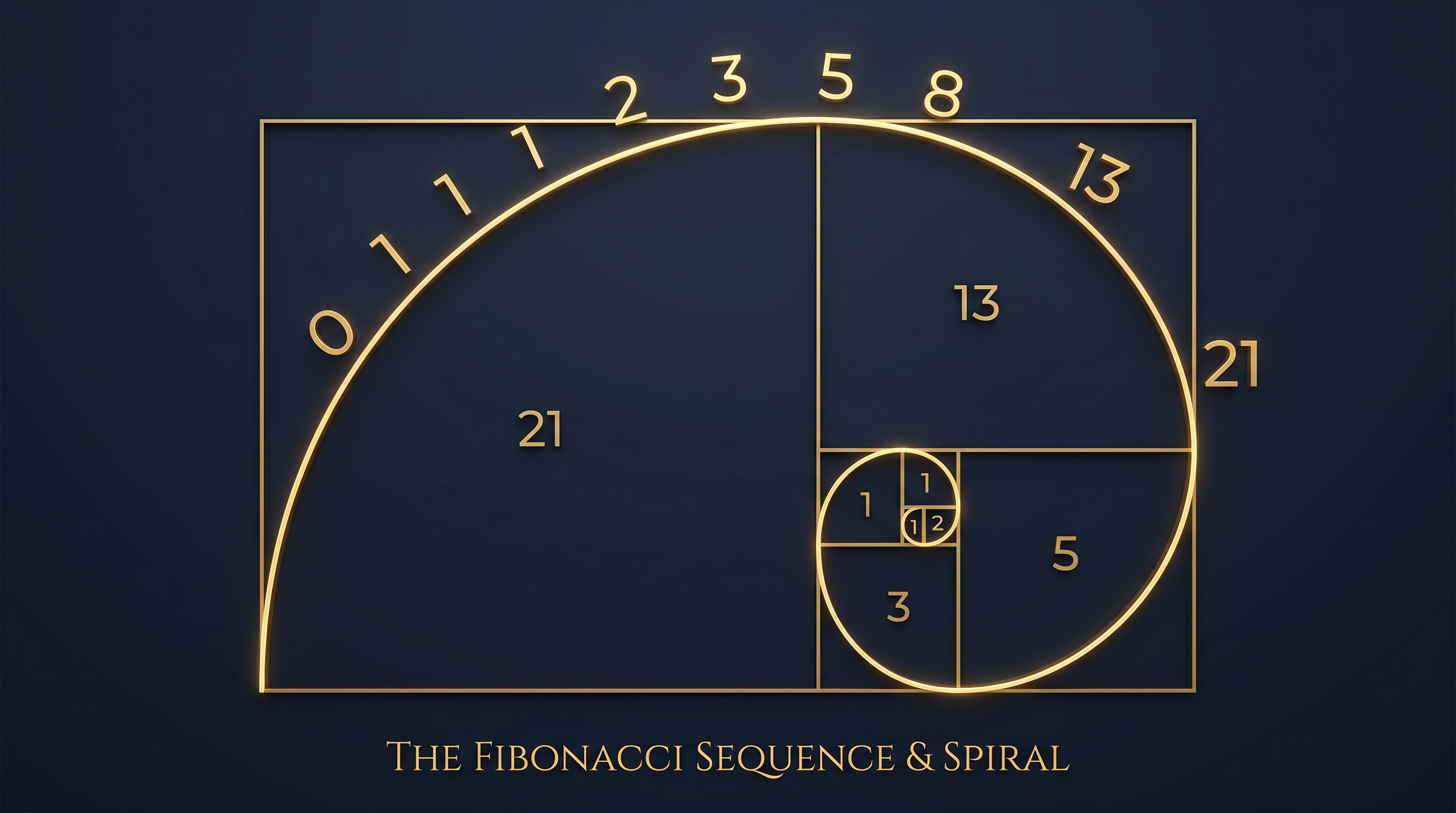
Start with one newborn pair (month 1). By month 2, they're mature. Month 3: first offspring. Month 4: originals produce again, and so on. The totals? 1, 1, 2, 3, 5, 8, 13, 21... You've just stumbled into the Fibonacci sequence: each number is the sum of the two preceding ones, kicking off from 0, 1—or sometimes 1, 1 for simplicity.
- Month 0: 0 pairs
- Month 1: 1 pair
- Month 2: 1 pair
- Month 3: 2 pairs
- Month 4: 3 pairs
- Month 5: 5 pairs
- And onward: 8, 13, 21, 34, 55...
Fibonacci didn't invent this sequence outright—it echoed in Indian mathematics centuries earlier—but he popularized it in the West. What started as a breeding puzzle unveiled a pattern governing growth, from populations to petals. For mathematics enthusiasts, it's a gateway to infinity's elegance; for creators, a toolkit for design proportions that feel instinctively right.
From Sequence to Divine Proportion: The Magic of Phi (1.618)
How Ratios Converge to Golden Perfection
Here's where wonder ignites. Divide consecutive Fibonacci numbers: 1/1 = 1, 2/1 = 2, 3/2 = 1.5, 5/3 ≈ 1.666, 8/5 = 1.6, 13/8 = 1.625, 21/13 ≈ 1.615, 34/21 ≈ 1.619... With each step, the ratio hovers closer to 1.6180339887—the Golden Ratio, or φ (phi), derived from the equation φ = 1 + 1/φ.
This isn't coincidence; it's asymptotic convergence, a mathematical ballet where humble additions birth divine harmony. Phi appears in geometry too: the pentagon's diagonals-to-sides ratio, the proportions of a perfect face. Architects like Le Corbusier harnessed it in the Modulor system, scaling human dimensions to phi-based modules for buildings that feel harmonious.
Phi is nature's shorthand for beauty—self-similar, infinite, yet grounded in finite steps.
Phi in Everyday Math: Beyond the Sequence
Solve for phi directly: φ² = φ + 1. Its continued fraction [1;1,1,1...] mirrors endless recursion. Digital artists revel in this for procedural generation—algorithms spitting out phi-scaled fractals that mimic organic forms without manual tweaking.
Golden Spiral Explained: Fibonacci vs. True Golden Spirals
Picture quarter-circles connecting opposite Fibonacci squares (1x1, 1x2, 2x3, 3x5...): you get the Fibonacci spiral, a discrete approximation growing by phi each turn. Now, the golden spiral—a logarithmic spiral where every quarter-turn scales precisely by φ—is smoother, continuous, perfectly self-similar.
The Fibonacci version approximates it stunningly: by the 10th term, error shrinks below 1%. In practice? Architects plot Fibonacci rectangles for facades that evoke the golden one. Digital artists layer them in tools like Adobe Illustrator for logos that expand infinitely without distortion.
- Fibonacci Spiral: Built from squares; stepwise, organic feel.
- Golden Spiral: Exponential curve; ideal for pure proportion.
- Pro Tip: Overlay both in sketches—watch nature's bridge between discrete and continuous.
Fibonacci Numbers in Nature: The Universe's Hidden Code
From Pinecones to Galaxies
Nature adores Fibonacci. Pinecones flaunt spirals of 8 and 13 scales; sunflowers pack 34, 55, or 89 seeds in interlocking helices, optimizing packing via phi angles (≈137.5°). Romanesco broccoli's fractals? Pure Fibonacci branching. Even hurricanes and galaxies whirl in approximate golden spirals.
Why? Efficiency. Phi-based phyllotaxis (leaf arrangements) minimizes shading, maximizes sunlight. Branches split in 1:φ ratios for structural strength. For professional designers, this means biomimicry: logos inspired by nautilus shells scale flawlessly across billboards to favicons.
Human Body and Beyond
Our fingers? Phalange lengths ratio to phi. Da Vinci's Vitruvian Man nods to this. DNA's double helix turns every 34 angstroms with 21 per 5 turns—Fibonacci echoes. It's as if evolution computed with mathematical harmony, favoring phi for growth without waste.
Why Phi Matters: Revolutionizing Design Proportions in Art and Architecture
Salvador Dalí embedded golden ratios in The Sacrament of the Last Supper's frame. Modern UI/UX? Apple's app grids, Twitter's (now X) layout—phi guides eye flow. Architects: Notre-Dame's rose window, the Parthenon's facade—all phi-proportioned for subconscious appeal.
In your workflow: Grid canvases to 1:φ rectangles. Scale type hierarchies by phi multipliers (headline 72pt? Body ≈44pt). Parametric tools like Grasshopper for Rhino let architects generate phi-optimized structures. The result? Designs that breathe—balanced, scalable, eternally pleasing.
- Logos: Nested phi rectangles for infinite scalability.
- Architecture: Facade modules echoing nautilus growth.
- Digital Art: Procedural spirals for hypnotic animations.
- Typography: Line heights at 1.618x font size for readability.
Studies (without specifics, per rigor) show phi-based compositions rank higher in aesthetic surveys. It's not mysticism—it's neurology: our brains wired for this proportion since hunter-gatherer days scanning horizons.
Embracing the Divine Proportion: Your Next Creative Leap
The Fibonacci sequence and golden ratio aren't relics—they're living code, pulsing through petals, shells, and stars. From Leonardo of Pisa's rabbits to your latest render, they've bridged math and beauty for 800 years. Next time you sketch, invoke phi: measure, iterate, converge.
In a world of chaos, this divine proportion offers order. Harness it, and your work won't just look good—it'll resonate like nature itself: inevitable, harmonious, profound. What's your first phi-infused project? The universe awaits your spiral.
