
Fibonacci Sequence & Golden Ratio: From Rabbit Rabbits to Divine Proportions & Phi Magic
Imagine a humble rabbit burrow sparking a mathematical revolution that echoes through sunflowers, symphonies, and your next architectural blueprint. This isn't fantasy—it's the origin story of the Fibonacci sequence, a series of numbers that unlocks the divine proportion known as Phi, the golden ratio's enigmatic heart. For designers, architects, digital artists, and math enthusiasts, mastering this mathematical harmony isn't just elegant—it's a superpower for crafting compositions that feel instinctively right.
In this deep dive, we'll trace the Fibonacci numbers from their surprising roots to their convergence with the golden ratio, explore their blueprints in nature and art, and equip you with precision tools to infuse your work with design proportions that captivate. Buckle up: the journey from rabbit pairs to Phi magic awaits.
The Rabbit Problem that Changed Mathematics
Picture medieval Italy, 1202. A young mathematician named Leonardo of Pisa—later dubbed Fibonacci—poses a deceptively simple puzzle in his book Liber Abaci: How many pairs of rabbits can a single pair produce in a year, assuming each mature pair births one new pair monthly and no rabbits die?
Start with one newborn pair (month 1). By month 2, they're mature but childless. Month 3: one new pair arrives, totaling two pairs. Month 4: the originals produce another, now three pairs. The pattern accelerates: 1, 1, 2, 3, 5, 8, 13, 21... Each term is the sum of the two preceding ones. These are your Fibonacci numbers, named after their discoverer, though the sequence whispers through ancient Indian texts centuries earlier.
Leonardo of Pisa didn't just tally bunnies; he revolutionized European mathematics by introducing Hindu-Arabic numerals, paving the way for modern computation. But the real magic? This sequence doesn't stop at rabbits—it permeates the universe.
Cracking the Code: How Fibonacci Numbers Work
The Fibonacci sequence begins: 0, 1, 1, 2, 3, 5, 8, 13, 21, 34, 55, 89, 144, 233, 377, and so on. Formally, F(0) = 0, F(1) = 1, and F(n) = F(n-1) + F(n-2) for n > 1.
Why does this matter for creatives? Ratios between consecutive Fibonacci numbers approximate the golden ratio, or Phi (φ ≈ 1.6180339887). Check these examples:
- 8 / 5 = 1.6
- 13 / 8 = 1.625
- 21 / 13 ≈ 1.61538
- 34 / 21 ≈ 1.61905
- 55 / 34 ≈ 1.61765
- 144 / 89 ≈ 1.61798
- 233 / 144 ≈ 1.61805
- 377 / 233 ≈ 1.61803
See the convergence? As numbers grow, the ratio dances closer to φ. This Fibonacci and golden ratio link is no coincidence—it's the sequence's DNA.
Convergence: Where Fibonacci Meets Phi
The Divine Proportion Unveiled
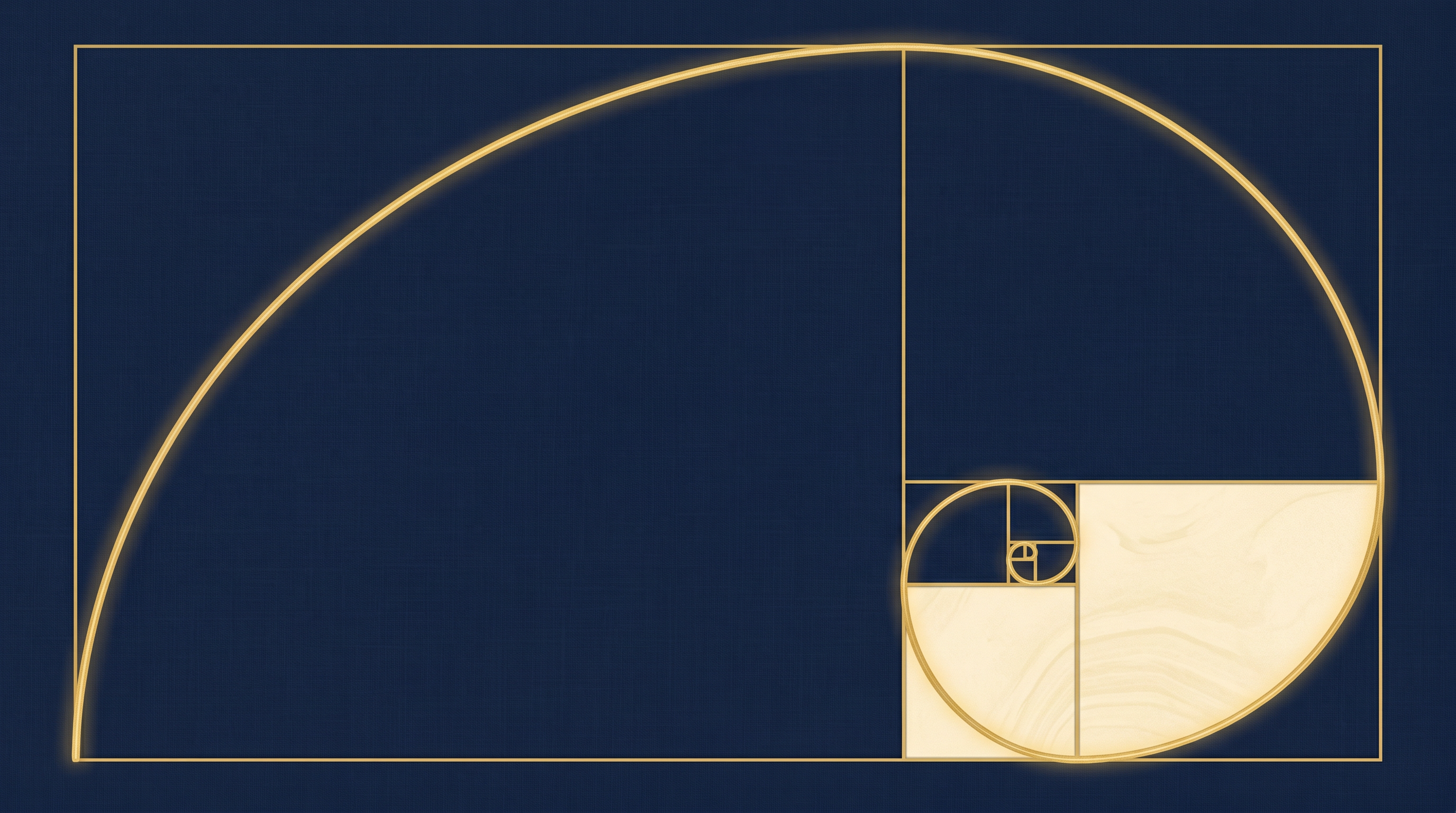
Phi emerges from solving x² = x + 1, yielding φ = (1 + √5)/2 ≈ 1.618. The divine proportion has seduced minds from Euclid to Da Vinci, who called it the "sectio aurea." A golden rectangle embodies it: sides in ratio φ, where removing a square leaves another golden rectangle—infinitely self-similar.
Fibonacci numbers build these rectangles seamlessly: a 13x8 yields a near-perfect golden frame. Architects like Le Corbusier wielded this in the Modulor system for human-scaled harmony.
Spirals: Fibonacci vs. Golden
Don't confuse the Fibonacci spiral with the true Golden spiral. The former arcs quarter-circles through Fibonacci squares (1,1,2,3,5...), creating a jagged approximation. The latter, logarithmic and geometrically pure, expands by φ every quarter-turn—smoother, more hypnotic.
In design, the Golden spiral guides the eye with effortless flow; the Fibonacci spiral offers organic, nature-mimicking texture.
Nature's Masterclass in Packing Efficiency
Why do pinecones sport Fibonacci spirals? Efficiency. Sunflower seeds pack via Fibonacci numbers (often 55/34 or 89/55), minimizing gaps while maximizing density. Phyllotaxis—the spiral leaf arrangement—follows φ angles (≈137.5°), preventing overlap and shadowing.
Nautilus shells and galaxy arms trace Golden spirals. This biological logic isn't random evolution—it's physics favoring growth patterns that tile space optimally. For digital artists, replicating these yields visuals that resonate subconsciously.
Phi's Reach: Trading, Music, and Beyond
Fibonacci Retracements in Trading
Traders slice charts with Fibonacci retracements: 23.6%, 38.2%, 50%, 61.8% (φ inverse), 78.6%—derived from Fibonacci sequence ratios. These predict pullbacks with eerie accuracy, blending math and market psychology.
The Mathematical Structure of Music
Bartók and Debussy wove φ into compositions; scales and chord progressions echo Fibonacci intervals. Piano keys cluster in 13 (prime Fibonacci), and the beat hierarchy (whole/half/quarter) mirrors the sequence. This mathematical harmony explains why certain melodies "feel" perfect.
Mastering Phi in Your Creative Arsenal
Architects, sketch facades with golden rectangles. Digital artists, overlay Fibonacci grids in Photoshop for balanced compositions—think Apple's logo or the Parthenon's pediment. Logo designers: subdivide paths by φ for timeless appeal.
Precision demands tools. Enter the GetRatioGolden calculator: input dimensions, snag exact φ multiples, generate spirals, and export grids. It's your shortcut to design proportions that align with nature's code—no guesswork.
- Measure your canvas.
- Divide by φ for subsections.
- Place focal points at spiral intersections.
- Iterate with Fibonacci squares for texture.
Test it: a 1440x890 poster (Fibonacci dimensions) feels vast yet intimate. Your audience won't know why—they'll just love it.
The Eternal Allure of Phi Magic
From Leonardo of Pisa's rabbits to your screen's pixels, the Fibonacci sequence and golden ratio reveal a universe wired for beauty. It's not mysticism—it's math manifesting as harmony. Dive in, calculate boldly, design with Phi, and watch your work transcend the ordinary.
Ready to unlock divine proportions? Grab the GetRatioGolden calculator and let the magic unfold.
