
15 Stunning Examples of the Golden Ratio in Nature
Imagine a sunflower turning its face to the sun, its seeds packed in mesmerizing spirals that seem to whisper ancient secrets. What if that beauty wasn't random, but governed by a single number—φ ≈ 1.618033, the Golden Ratio, or Divine Proportion? This mathematical harmony isn't mere coincidence; it's nature's blueprint for efficiency, growth, and structural perfection. For professional designers and architects, recognizing the golden ratio in nature unlocks professional precision in mimicking these naturally pleasing forms. And for nature enthusiasts, it's a reminder that the universe pulses with mathematical patterns in nature.
Phi emerges from the Fibonacci sequence, where each number is the sum of the two preceding ones: 1, 1, 2, 3, 5, 8, 13, and so on. Dividing consecutive terms approximates φ ≈ 1.618033—the ratio that defines spirals, proportions, and fractals. In biology, this phi in biology strategy maximizes space, light, and strength, turning chaos into elegance. From microscopic DNA to galactic arms, the Divine Proportion reveals why nature designs with such flawless economy. Let's explore 15 stunning examples of the golden ratio in nature and Fibonacci sequence nature wonders.
1. Sunflower Seed Spirals: Optimal Packing Mastery
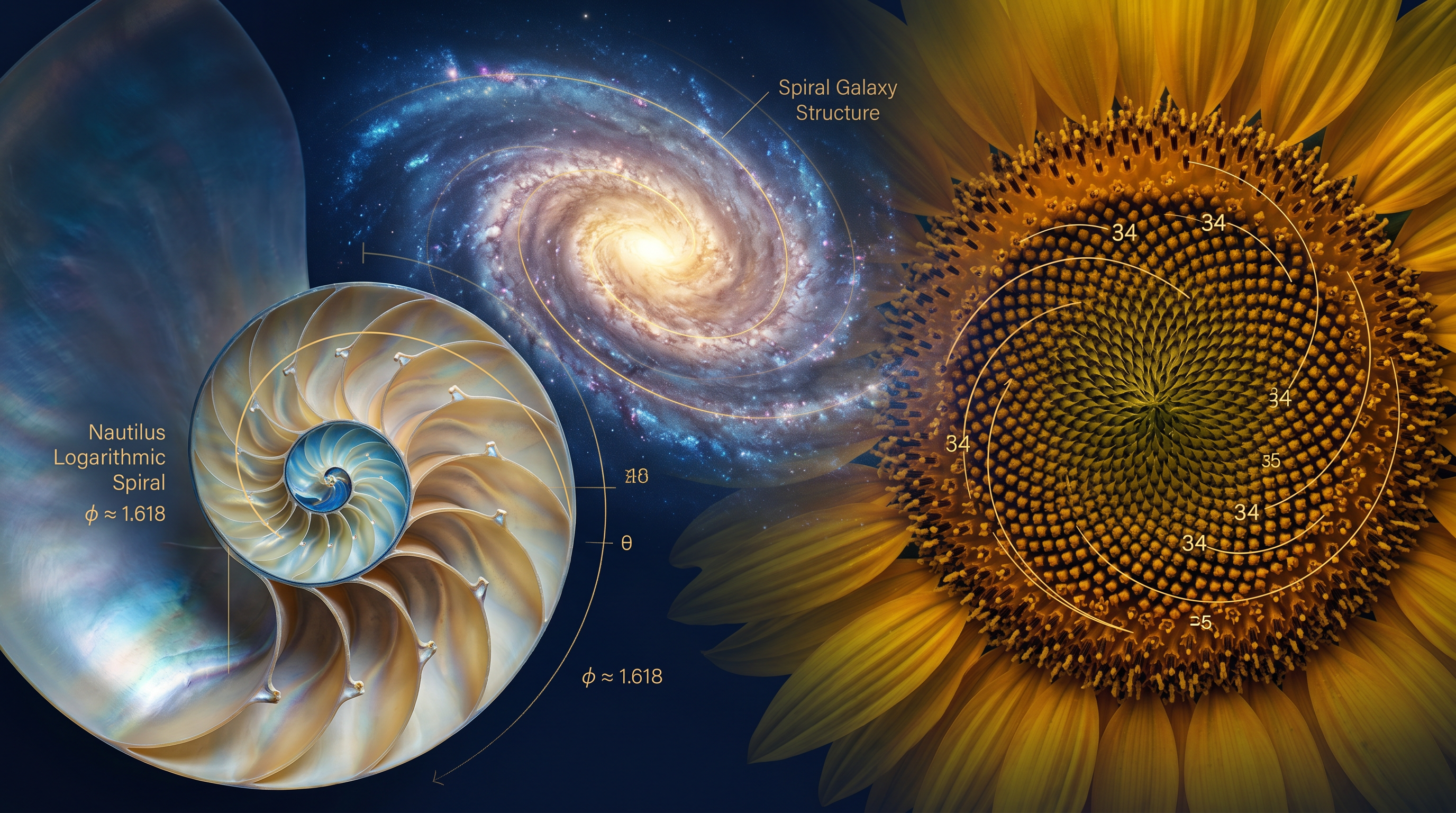
Stand before a sunflower's disk, and you'll see spirals radiating in two directions—often 34 one way, 55 the other, both Fibonacci numbers. These curves follow Fermat's spiral, unfurling at the golden angle of 137.5 degrees, derived from φ ≈ 1.618033. Each new seed nudges into place at this precise interval, ensuring no gaps or overlaps.
This mathematical harmony benefits the plant profoundly: maximum seed density for reproduction, while allowing sunlight to penetrate evenly. Designers draw from these divine proportion examples for layouts that feel intuitively balanced.
2. Nautilus Shells: Logarithmic Spirals of Growth
Dive into the ocean's depths, and the nautilus shell reveals a logarithmic spiral where each chamber expands by φ ≈ 1.618033. As the creature grows, it builds larger rooms, always maintaining the Divine Proportion between successive whorls.
Why this form? It provides professional precision in buoyancy control and structural integrity, distributing pressure evenly across the shell. The result is a naturally pleasing curve that architects emulate in modern spirals, echoing golden ratio in nature.
3. Pinecones: Opposing Fibonacci Spirals
Crack open a pinecone, and count the scales: typically 8 spirals one way, 13 the other—Fibonacci perfection. These interlocking patterns spiral at angles tied to φ ≈ 1.618033, creating a tight, armored cone.
The advantage? Seeds are shielded yet poised for release, with optimal packing for wind dispersal. This Fibonacci sequence nature display offers nature enthusiasts a portable lesson in efficient design.
4. Hurricanes: Storm Clouds in Divine Swirls
From space, hurricanes spiral like cosmic nautiluses, their arms curving logarithmically with ratios approximating φ ≈ 1.618033. Winds accelerate outward, tracing the golden angle for momentum efficiency.
This mathematical patterns in nature funnels energy inward, sustaining the storm's power while minimizing drag. Architects study these for fluid dynamics in building ventilation.
5. Spiral Galaxies: Phi on a Cosmic Scale
Our Milky Way's arms wind in logarithmic spirals governed by φ ≈ 1.618033, with stars and gas clouds spaced in golden proportions. This macro manifestation of the Divine Proportion spans light-years.
It stabilizes the galaxy, preventing stellar collisions while promoting star formation. A reminder that phi in biology principles scale to the universe's architecture.
6. Flower Petals: Fibonacci Counts in Bloom
Lilies boast 3 petals, buttercups 5, delphiniums 8—all Fibonacci numbers. These arrangements circle the center at golden angles, ratios rooted in φ ≈ 1.618033.
Petals maximize pollinator visibility and sunlight exposure without shading each other. These divine proportion examples inspire floral motifs in graphic design.
7. Tree Branches: Branching for Light Optimization
Observe a tree's crown: branches fork in ratios near φ ≈ 1.618033, creating fractal-like canopies where each level receives proportional light.
This golden ratio in nature ensures photosynthesis efficiency, with minimal material for maximum reach. Architects apply it to urban green spaces for shade harmony.
8. Fern Fronds: Fractal Spirals Unfurling
Fern fronds uncoil in spirals approximating the golden angle, their pinnae repeating at φ ≈ 1.618033 scales—a self-similar fractal dance.
This promotes rapid growth in shaded forests, capturing light efficiently. A naturally pleasing model for parametric design software.
9. Romanesco Broccoli: Fractal Geometry Perfected
This veggie is a fractal masterpiece: each floret is a smaller copy of the whole, with cone angles and sizes in golden ratios derived from φ ≈ 1.618033 and Fibonacci.
It packs nutrients densely, resisting pests through irregularity. Mathematical harmony at the dinner table—ideal for biomimetic architecture.
10. Animal Body Proportions: Dolphins to Penguins
Dolphins' snouts to bodies, penguins' flippers to torsos—many ratios hover near φ ≈ 1.618033, balancing hydrodynamics and agility.
This Divine Proportion streamlines movement, reducing drag for energy savings. Designers use it for ergonomic forms that feel intuitively right.
11. Honeybee Family Trees: Fibonacci Ancestry
In a hive, a drone's female ancestors follow Fibonacci: 1 parent, 2 grandparents, 3 great-grandparents, up to φ ≈ 1.618033 ratios in lineage branching.
This genetic efficiency bolsters colony resilience. A subtle Fibonacci sequence nature in social biology.
12. DNA Molecules: Phi in Genetic Code
DNA's double helix turns every 34 angstroms, with width-to-length ratios approximating φ ≈ 1.618033, echoing Fibonacci.
It compacts the genome tightly yet accessibly, life's phi in biology foundation. Architects ponder its twist for helical structures.
13. Ocean Waves: Golden Curves in the Surf
Breaking waves arc in logarithmic curves where height-to-wavelength ratios near φ ≈ 1.618033, optimizing energy transfer from wind to foam.
This powers coastal ecosystems sustainably. Surfers and coastal engineers chase this mathematical patterns in nature.
14. Snail Shells: Mini Logarithmic Wonders
Like nautiluses but terrestrial, snail shells spiral logarithmically at φ ≈ 1.618033 expansions, protecting the soft body within.
Strength-to-weight perfection for mobility. These divine proportion examples scale nature's spiral genius.
15. Human Hand Bones: Finger Segments in Phi
Your finger bones divide in golden ratios: proximal to middle near φ ≈ 1.618033, middle to distal likewise—Fibonacci precision in phalanges.
This grants dexterity for tool use, a pinnacle of golden ratio in nature. It explains why Vitruvian proportions captivate designers.
From seeds to stars, the Divine Proportion weaves through existence, offering professional precision that inspires. Next time you sketch or build, let φ ≈ 1.618033 guide you—nature's ultimate blueprint awaits.
